
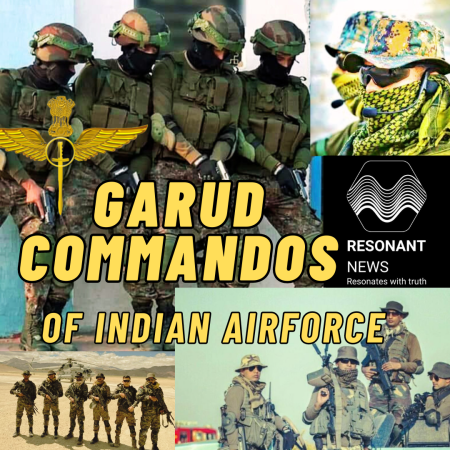

Garud is the mount of Lord Vishnu and is recognized as the God of Strength and Vigilance. Such a name was apt for the Special Force that the Indian Air Force created in 2004.
The genesis of this force was the two major attacks on the Air Force stations in north India in late 2001. These attacks were repulsed with great aplomb by the IAF personnel.
However, it was felt that although the army provided an outer protection ring around vulnerable areas and air bases, there needed to be a certain amount of permanence in the protection, which is necessary. Army units tend to move after a short deployment, leading to almost complete loss of Human Intelligence.
In a short period, a plan was put into place to create a force (known initially as the Tiger Force) with roughly 2100 men trained on the lines of Special Forces of the army. The government approval for forming this cadre of soldiers now named ‘Garud’ was approved in 2003. It was to have 1080 men in the initial phase.
Birth of Garud Force
Out of 100 airmen selected in 2004, only 62 actually completed the difficult training. When compared to MARCOS & the Army SF troops, the training is one year long, but the difference is that the initial airmen training forms a part of it. Since these are initially raw recruits. Thus, on 06 Feb 2004, just about two years after the 23 October 2001 attack in Kashmir, this force came into being.

Training Aspects
The total time required to produce a fully trained Garud troop is long, like it is for any specialization in the forces. The training period duration is 72 weeks. The initial training after completion of the basic airmen training (which is mainly conducted at Belgaum in Karnataka), the troops undergo a three-month probationary period, where extensive toughening is done. This, like almost all other stages of Garud training, has a low success rate. Several volunteers fall by the wayside. The officers of the Garud branch are selected and trained in a similar manner. The initial phase of training is conducted at the special facility at Garud Regimental Training Centre at Air Force Station, Chandinagar.

The subsequent Special Operations training involves a lot of interaction and integration with Special Forces units, Special Frontier Force, and others. The para jump training is conducted by the Para Training School (PTS). The special training is imparted at Counter-insurgency and Jungle Warfare School (CIJWS) and similar institutions.
The final phase is where Garud troops are actually deployed with Army SF units to gain critical operational experience. They also continue to specialize in explosives and weapon handling.
The Air Force has now possessed this force for the past 19 years. It has teams of 100 people each, with a Flight Lieutenant or a Squadron Leader as the boss. There are about 15-20 such teams deployed all over India. Two teams are usually on deployment with the army special forces and have been appreciated for their tenacity and professionalism.
The Garud troops are well-equipped; they possess sophisticated weapons like Sig Sauer, AK-series assault rifles along with the Israeli Tavor rifles and their different variants. The troops also have the Negev light machine guns along with the Galil sniper rifles which can take out enemy troops from a range of up to 1000 meters.

The Garuds used the Negev LMG in the famous operation in Jammu and Kashmir where five terrorists were killed by the Garud team, and Corporal Jyoti Prakash Nirala was awarded the Ashok Chakra posthumously.

Corporal Jyoti Prakash Nirala
Even in the recent evacuation missions from the highly volatile Kabul and Wadi Sayyidna in Sudan, Garud was an integral member of the aircraft team that goes into inhospitable locations. Whether it’s the Kashmir Valley or the Doklam situation, Garuds are deployed as a necessity; they are no longer the new kids on the block.
With one Ashok Chakra and Eight Shaurya Chakras, Garud is a successful endeavor by the Indian Armed Forces. The gallantry medals awarded to them are also substantial.
It’s a small force with great capabilities, potential, and ambitions. More power to them

Leave a Reply