
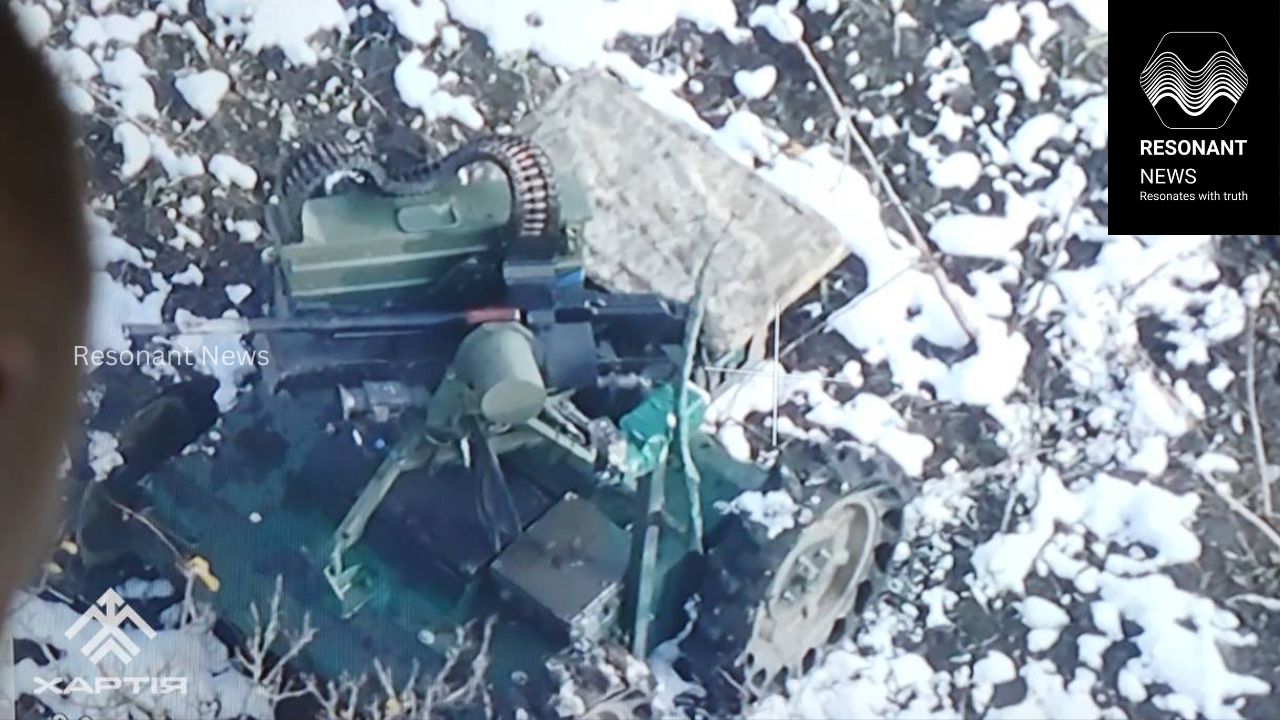

Ukrainian forces have reportedly conducted a groundbreaking operation exclusively using unmanned ground vehicles (UGVs) and first-person view (FPV) drones, showcasing the country’s continued innovation in leveraging technology to compensate for manpower shortages. This first-of-its-kind ground attack marks a significant milestone in the integration of robotics into military strategy.
Battle of Lyptsi
According to a spokesperson from the Khartiia Brigade, a unit formed in March 2022 and assigned to Ukraine’s National Guard under the Ministry of Internal Affairs, the attack occurred near Lyptsi, north of Kharkiv City, on an unspecified date. The National Guard, known for its focus on technological advancements, established the Typhoon specialized unit in August 2023, which operates exclusively with uncrewed systems. While it has not been officially confirmed, the Typhoon unit is likely to have participated in or supported the operation’s preparations.
During the attack, Ukrainian forces deployed dozens of UGVs armed with machine guns to engage Russian positions. These robotic systems also played a key role in laying and clearing mines in contested areas. Notably, the mission was executed without any direct involvement of infantry, successfully neutralizing unspecified Russian targets.
Ukraine’s reliance on innovative technologies stems from the need to address significant manpower disparities. In stark contrast to Russia’s strategy of sustaining high casualty rates for marginal territorial gains, Ukraine has focused on asymmetric strike capabilities and technological advancements to offset its numerical disadvantage.
This operation demonstrates how UGVs and drones can revolutionize battlefield tactics by reducing risks to personnel and enabling precise strikes. Such innovations are particularly vital given Ukraine’s struggle to defend against a Russian military force that often outnumbers its defenders, as evidenced by the reported 6,000-strong Russian force advancing on just 2,000 Ukrainian defenders in the Lyptsi area.
In addition to UGVs, Ukraine continues to push boundaries in aerial drone development. The Ukrainian General Staff recently announced the successful testing of a drone equipped with fiber optic cables, designed to resist electronic warfare (EW) interference—an area where Russian forces have also been active.
A Ukrainian drone manufacturer has further advanced domestic production capabilities by assembling a prototype FPV drone made entirely from components manufactured in Ukraine. Such developments reduce reliance on imported materials and bolster Ukraine’s self-sufficiency in defense technology.
Implications for Modern Warfare
The Battle of Lyptsi may prove to be a defining moment in the evolution of warfare. While the full historical significance of the event remains for future historians to assess, it is already evident that it marks an important step in transforming the nature of war. Once a purely human endeavor, warfare is now incorporating robotic systems and autonomous technologies, redefining its character for the 21st century.
The Lyptsi operation is a vivid illustration of how robotic systems are reshaping the future of warfare. The deployment of unmanned systems not only mitigates risks to human soldiers but also enhances operational efficiency in challenging environments.
While reminiscent of science fiction, Ukraine’s use of autonomous and remote-controlled systems signals a shift in military paradigms. As these technologies evolve, their impact on strategic planning and battlefield dynamics will likely expand, offering smaller nations a means to counterbalance larger adversaries through innovation.
The successful integration of robotics and drones by Ukrainian forces underscores the transformative potential of technology in modern warfare, setting a precedent for other nations facing similar challenges.


Leave a Reply