
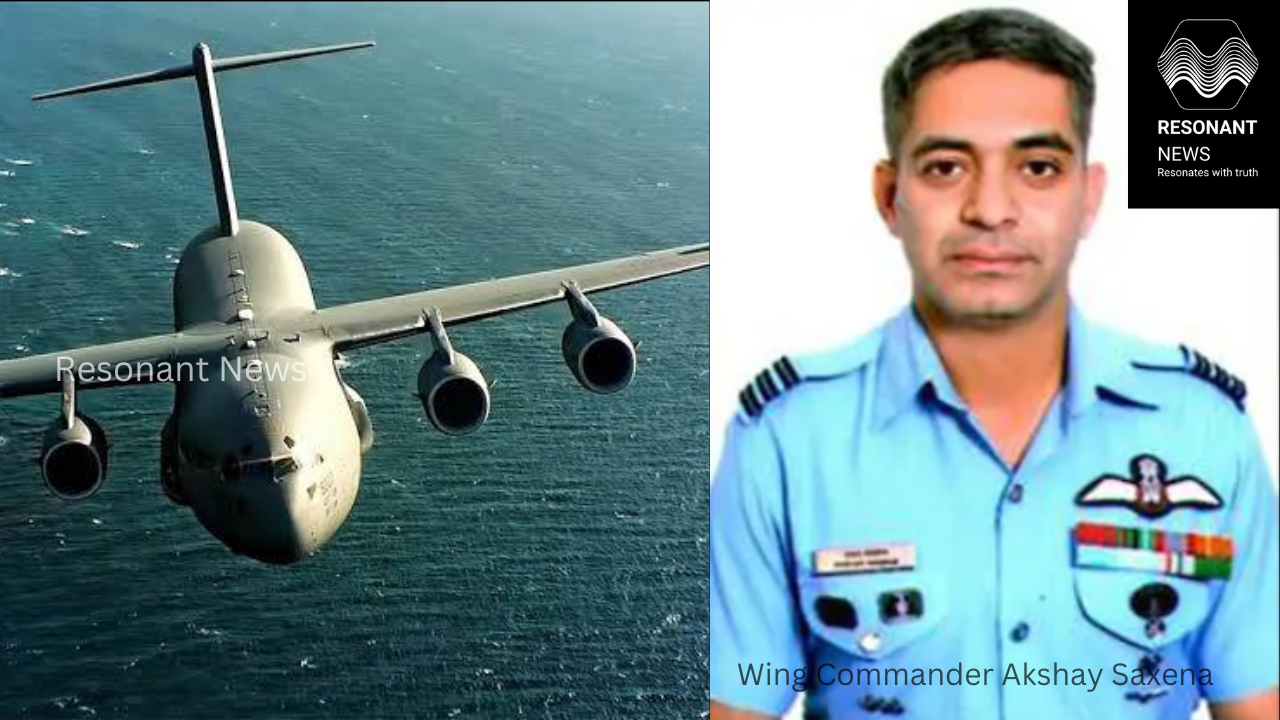

In a landmark event, Wing Commander Akshay Saxena of the Indian Air Force (IAF) was honoured with the Vayu Sena Medal for gallantry, marking the first time a C-17 Globemaster pilot has received such recognition. This commendation was awarded for his pivotal role in a high-stakes anti-piracy mission off the Somali coast, approximately 1,450 nautical miles from Mumbai.The mission involved real threats, including flying into the airspace of another country undeclared and undetected for close to four hours.
Mission Overview:
On December 13, 2023, the Indian Navy’s stealth-guided missile destroyer, INS Kolkata, intercepted the merchant vessel MV Ruen (17 crew members), which had been hijacked by 35 Somali pirates. The confrontation escalated when the pirates opened fire on INS Kolkata and downed one of its drones.
In a supremely quick response, the IAF and Indian Navy launched a coordinated operation to neutralize the threat and rescue the vessel’s 17-member crew.
Tactics and Execution:
At the outset a P-8I set up station to ensure uninterrupted radar control and surveillance off the African coast. Another Medium altitude long endurance drone on station meant the stage was set for the show stopper to enter the scene.
The grand plan was to airdrop the Special Forces especially trained and equipped for the Maritime environment, namely the Marine Commando’s known to the world as MARCOS. They would be the Boots in the water (so to speak) to retake the hijacked vessel. This was precisely what the armed forces train for, an Out Of Area Contingency, with a whole lot of variables and unpredictable conditions thrown in.
Wing Commander Saxena captained a C-17 Globemaster III, transporting 18 MARCOS along with two Combat Rubberized Raiding Craft (CRRC) boats. The operation required a long flight over sea with minimal communication. A precision airdrop over the high seas, a maneuver fraught with challenges due to variable sea and air conditions affecting accuracy.
The inherent risks of parachuting into water further compounded the mission’s complexity, especially given the time of day with its low light conditions.
To minimize detection, Saxena made the strategic decision to switch off all electronic emitters and fly at a low altitude over international waters, venturing into foreign airspace without prior declaration.
The aim was to enhance the element of surprise (to the pirates – the element of shock and awe were maximised). The airdrop was executed at dusk, a time chosen to leverage reduced visibility conditions, thereby decreasing the likelihood of detection by hostile forces. The final drop zone was provided when the aircraft was merely 50 nautical miles inbound to the DZ (drop zone). the crew ably led by Saxena adeptly guided his crew to perform a precise airdrop, facilitating the successful capture of the pirates and the safe rescue of the MV Ruen’s crew. The MARCOS did a splendid job retaking the ship.
Crew Skills and Coordination:
The success of this mission underscores the exceptional skills and training of the C-17 crew. Operating the C-17 in such a high-risk environment demanded advanced proficiency in low-level navigation, threat evasion, and precise airdrop techniques. The crew’s ability to adapt to dynamic mission parameters, such as the late change in drop location, highlights their flexibility and decision-making capabilities under pressure.
Furthermore, this operation exemplifies effective inter-service coordination between the IAF and the Indian Navy. Maintaining operational secrecy over the course of the nearly 10-hour mission required seamless communication and collaboration. Wing Commander Saxena’s leadership ensured that all aspects of the mission were meticulously planned and executed, reflecting a high degree of professionalism and jointmanship.
Insights:
This mission highlights the strategic versatility of the C-17 Globemaster III in unconventional roles beyond standard airlift operations. Its capability to conduct low-level flights and perform precise airdrops makes it an invaluable asset in special operations, including maritime interdiction and anti-piracy efforts.
The flexibility and adaptability demonstrated in this mission is crucial in modern warfare, where asymmetrical threats often require innovative and untested approaches for a quick response. These missions also have virtually no room for error.
In conclusion, Wing Commander Akshay Saxena’s exemplary performance in this daring mission not only thwarted a piracy threat but also set a precedent for the effective use of strategic airlift platforms in special operations. His actions reflect the highest standards of courage, skill, and inter-service cooperation within the Indian Armed Forces.
Jai Hind.


Leave a Reply