
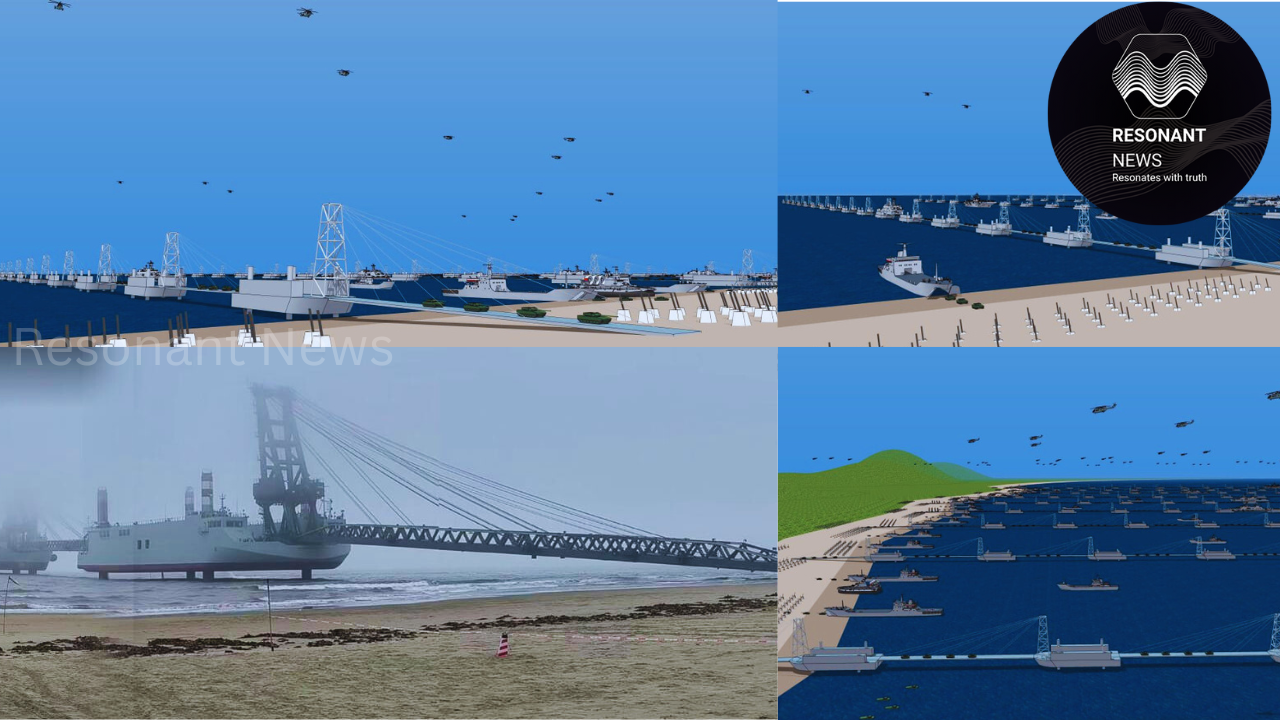

China has developed a sophisticated barge system designed to support landing operations in the event of a conflict with Taiwan. Incorporating civilian roll-on/roll-off (Ro-Ro) technology, the specialized barges demonstrate China’s advancing civil-military fusion strategy. Engineered to unload heavy equipment directly onto coastal roads, these vessels enhance the PLA’s maritime transport capabilities and enable flexible, multi-point landings, bypassing conventional coastal defenses. The specialized barges are equipped with a deployable bridge over 120 meters long, enabling direct offloading onto challenging shorelines, including rocky coasts, river estuaries, and shallow beaches.
This system mirrors the functionality of the British Mulberry Harbors used during the Normandy landings in World War II, which were critical in bypassing damaged port infrastructure and rapidly unloading large amounts of supplies and troops directly onto the beach. The Chinese system is positioned to play a similarly crucial role in any future amphibious operation, enhancing the logistical capacity of the People’s Liberation Army (PLA) and providing strategic flexibility in the face of Taiwan’s challenging coastline.
Strategic Importance of the Barge System
The Chinese barge system is a key logistical tool, enabling the rapid transfer of heavy weapons, ammunition, medical supplies, food, and troops from ships to the shore. Its adaptability allows deployment in areas without existing port infrastructure or where such infrastructure has been destroyed — a significant advantage given Taiwan’s heavily protected and rugged coastline. Taiwan’s 1,600-kilometer coastline is characterized by steep terrain and a limited number of suitable landing zones, which would typically hinder large-scale amphibious landings. However, the barge system’s ability to create temporary supply lines and bypass port infrastructure could give Chinese forces a strategic edge by enabling quick reinforcement and resupply once a beachhead is established. The specialized barges are equipped with “jack-up pillars” that stabilize the platform in rough seas, effectively converting it into a temporary pier for tanks and heavy vehicles. This feature improves unloading efficiency and reduces reliance on fixed ports, supporting the PLA’s focus on rapid deployment. The open deck design further streamlines loading and unloading, optimizing logistics for fast-paced amphibious operations.
To enhance operational reliability, the barges are fitted with dual pilothouses and redundant propulsion systems, ensuring continued functionality even in the event of mechanical failure or damage. Satellite imagery analysis indicates that these design elements are tailored for high-intensity amphibious operations rather than civilian use.
Challenges
Despite its advantages, the barge system faces considerable vulnerabilities. Taiwan’s coastal defenses are well-equipped with long-range anti-ship missiles, coastal artillery, and radar-guided air defense systems. These defenses pose a significant threat to slow-moving or unprotected vessels, particularly during the critical initial phase of an amphibious assault. Any successful use of the barge system would require the PLA to neutralize Taiwan’s missile and artillery systems, ensuring a secure corridor for the barges to operate.
Taiwan’s military is also equipped with advanced U.S.-supplied weaponry, including Harpoon anti-ship missiles and the Patriot missile defense system. These assets could disrupt Chinese supply lines and inflict heavy losses on the barges. The risk posed by Taiwan’s precision-guided munitions underscores the need for the barge system to be integrated with broader offensive capabilities, such as Chinese air superiority, naval escorts, and electronic warfare measures. Effective suppression of Taiwan’s defenses would be essential for ensuring the barges’ safe deployment and operational success.
Part of China’s Broader Amphibious Strategy
The barge system reflects China’s broader effort to modernize and expand its amphibious warfare capabilities. Beijing is actively developing specialized landing craft designed to transport heavier equipment, such as tanks, directly onto Taiwan’s road networks. This capability would enable Chinese mechanized units to bypass Taiwan’s natural coastal barriers and rapidly advance inland once a secure beachhead is established. The ability to quickly build up combat power on the island could significantly enhance China’s operational tempo and strategic positioning in a conflict scenario.
China’s development of the barge system highlights its strategic focus on overcoming Taiwan’s defensive advantages and ensuring the PLA’s capacity to sustain large-scale amphibious operations. While Taiwan’s well-fortified coastline presents formidable challenges, the flexibility and logistical strength of the barge system could play a pivotal role in any future military confrontation.

Leave a Reply