
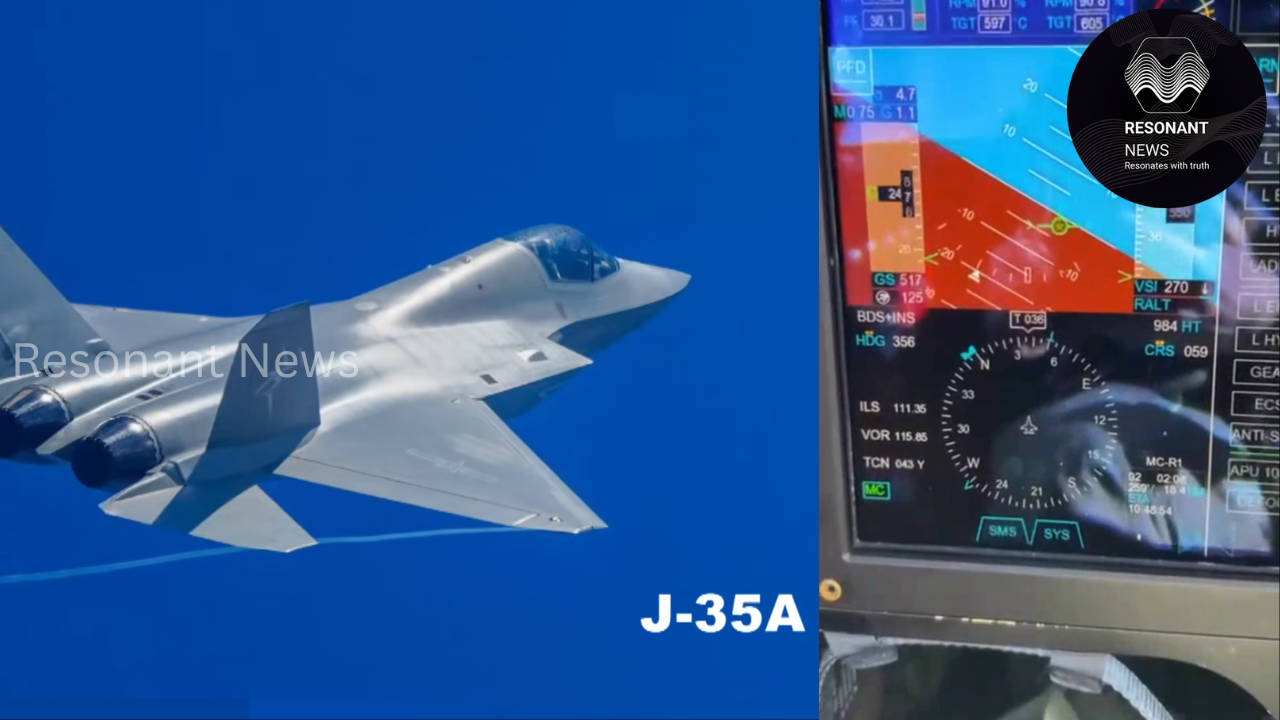

Recent video by Uzbeki social media account has stirred intrigue in military aviation circles, with claims that China has approved the sale of its fifth-generation J-35A stealth multirole strike fighter to the Uzbek Air Force. Adding fuel to the speculation, a video circulating online purportedly shows a pilot sporting Uzbek insignia training in a J-35A cockpit, where Chinese markings remain visible. While this suggests China is pushing its latest jet onto the global stage, the J-35A’s capabilities, production status, and international adoption remain shrouded in uncertainty. Is this fighter truly a leap forward for China—or just another bold claim awaiting proof?
China’s People’s Liberation Army Air Force (PLAAF) unveiled the J-35A at the 2024 Zhuhai Airshow, signaling its intent to integrate the jet into its ranks alongside the heavier J-20 “Mighty Dragon.” This makes China the second nation, after the U.S., to field two distinct fifth-generation stealth fighters. However, whether the J-35A is fully operational within the PLAAF remains unclear—official statements are vague, and production scale is anyone’s guess.
Beyond China, export efforts are picking up steam. Pakistan has been a vocal early adopter, with reports in 2024 indicating its air force pilots are training on the J-35A in China. Pakistani media suggest a deal for 40 jets, positioning it as a counter to India’s Rafale and Su-30MKI fleets. The Uzbekistan claim, if true, marks another step in China’s export push, though no official confirmation has surfaced, and the training video’s authenticity is unverified. Egypt has also been linked to negotiations for the FC-31/J-35 family, aiming to replace aging F-16s, but talks remain in limbo. Meanwhile, Saudi Arabia reportedly rebuffed an offer for the J-35A in 2025, opting for Western alternatives—a sign that China’s jet may not yet sway all buyers.
Skepticism: Promises vs. Reality
The J-35A looks impressive on paper, but there’s plenty of reason to question the hype. For starters, China’s track record with advanced fighter jets is mixed. The J-20, its first stealth fighter, faced years of engine woes and still relies on iterative upgrades to match Western rivals. The J-35A’s WS-19 engines, while a step forward, lack the proven reliability of American or Russian equivalents—could they falter under combat stress? Stealth is another gray area; without detailed data on its radar-absorbing materials or manufacturing precision, it’s hard to say if it rivals the F-35’s low-observable edge.
Production timelines raise further doubts. The carrier-based J-35 has been tested on the Liaoning, but serial production of either variant seems years away, especially given the complexity of scaling up a fifth-generation platform. The Uzbekistan and Pakistan deals, while promising, hinge on China delivering on time—something its aerospace industry has struggled with historically. And then there’s the espionage angle: U.S. officials have long alleged that the J-35A borrows heavily from stolen F-35 designs, a charge bolstered by their visual similarities. If true, this might accelerate development but doesn’t guarantee operational parity.
Globally, the J-35A lacks the logistical backbone that makes the F-35 a mainstay for the U.S. and its allies. Without a robust support network, its long-term impact—especially for export customers like Uzbekistan—could fizzle. And while China pitches it as a cost-effective alternative, nations like Saudi Arabia passing it over suggest it’s not yet a slam dunk in the competitive arms market.

Leave a Reply