
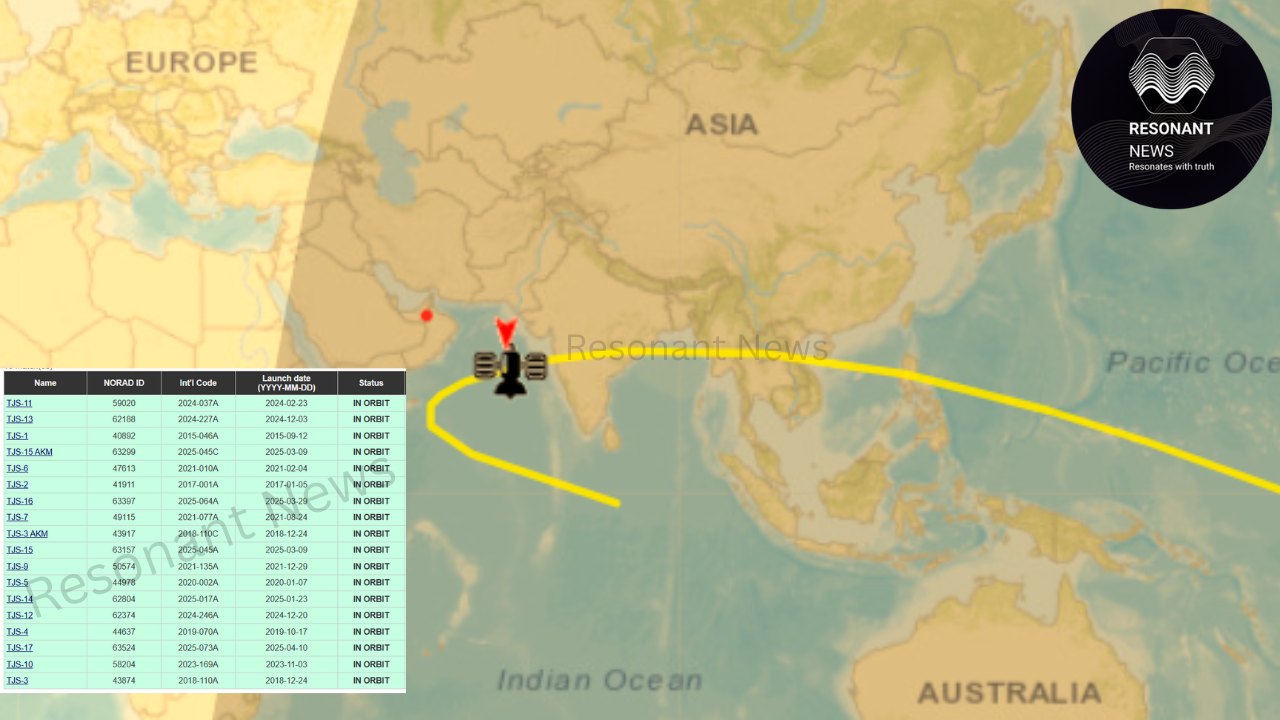

On [recent date, implied as April 2025], China successfully launched its third classified satellite, TJS-17, from the Xichang Space Center aboard a Long March 3B rocket. Dubbed the “King of the North” by observers, this launch is believed to complete a formidable orbital constellation known as the “Four Heavenly Kings,” with each satellite strategically positioned to monitor Earth from a cardinal direction. While Beijing officially describes the TJS series as testing “multi-band communications,” Western intelligence agencies suspect far more advanced and militarized objectives, intensifying concerns about China’s growing dominance in space.
The Tongxin Jishu Shiyan (TJS), or “Communications Technology Test,” series represents a secretive line of Chinese satellites launched since 2015. Publicly, China claims these satellites are designed for experimental purposes, primarily to test advanced communication technologies across multiple frequency bands. However, their orbital characteristics, secretive development, and lack of transparency have led analysts to believe they serve critical military and intelligence functions.
The TJS series includes several satellites, with TJS-17 being the latest, and is thought to form a cohesive network for strategic operations. Key features and suspected capabilities of the TJS satellites include:
- Signals Intelligence (SIGINT): TJS satellites are believed to intercept and analyze electronic communications, such as radio, radar, and satellite signals, providing China with insights into global military operations and communications networks.
- Satellite Tracking and Inspection: Some TJS satellites may have the ability to monitor or rendezvous with other satellites in orbit, potentially enabling China to assess or interfere with foreign space assets.
- Strategic Reconnaissance: Equipped with high-resolution imaging or other sensors, these satellites likely conduct detailed surveillance of military installations, naval movements, and critical infrastructure worldwide.
- Real-Time Monitoring: The constellation’s design suggests a capability for continuous, near-real-time observation of global military activities, giving China a significant edge in situational awareness.
The “Four Heavenly Kings” moniker reflects the strategic placement of these satellites, with each covering a cardinal direction (north, south, east, and west). TJS-17’s launch completes this network, positioning China to maintain comprehensive surveillance over key regions, including contested areas like the Indo-Pacific, the South China Sea, and beyond. The satellites’ geostationary or highly elliptical orbits allow them to linger over specific areas for extended periods, enhancing their intelligence-gathering potential.
The deployment of TJS-17 adds to China’s accelerating ambitions in space, a domain increasingly critical to global security and economic stability. While Beijing’s official narrative emphasizes peaceful technological advancement, Western analysts view the TJS series as a cornerstone of China’s military space strategy. The satellites’ suspected capabilities align with China’s broader efforts to modernize its People’s Liberation Army (PLA) and achieve information dominance in potential conflicts.
This launch comes amid rising tensions in space, as nations like the United States, Russia, and India bolster their own space-based capabilities. The U.S. Space Force, for instance, has repeatedly flagged China’s growing anti-satellite (ASAT) weapons and electronic warfare systems as threats to Western satellites. The TJS network’s ability to track and potentially target foreign space assets heightens these concerns, raising the specter of space becoming a battleground in future conflicts.
The completion of the “Four Heavenly Kings” network gives China an unparalleled vantage point in orbit, with implications for global security: The TJS constellation’s ability to monitor military activities in real time strengthens China’s strategic planning and response capabilities, particularly in regions where it seeks to assert influence, such as Taiwan, the South China Sea, and along its borders with India. The suspected satellite inspection capabilities of the TJS series could enable China to disrupt or neutralize adversary satellites, undermining critical communication, navigation, and reconnaissance systems relied upon by the U.S., NATO, and other allies. The lack of transparency surrounding the TJS program fuels mistrust, as China’s refusal to disclose detailed mission objectives aligns with its broader pattern of opacity in military advancements. This secrecy contrasts with international norms for space cooperation, further escalating tensions in an already competitive domain.
For India, China’s TJS-17 launch and the completion of the “Heavenly Kings” network pose specific security challenges: The TJS satellites’ reconnaissance capabilities could enhance China’s monitoring of sensitive areas along the Line of Actual Control (LAC), where India and China have faced repeated standoffs. Real-time intelligence could give China an edge in future border disputes. Enhanced surveillance over the Indian Ocean Region (IOR) could allow China to track Indian naval movements and strategic assets, undermining India’s maritime security and its role as a counterbalance to China in the Indo-Pacific. India, with its own growing space program, including the Indian Space Research Organisation (ISRO) and military satellites like GSAT-6A, faces increased pressure to counter China’s advancements. The TJS network’s capabilities highlight the need for India to accelerate its ASAT, electronic warfare, and space situational awareness programs to protect its orbital assets.
The launch of TJS-17 marks a significant milestone in China’s quest for orbital dominance, with the “Four Heavenly Kings” network cementing its status as a space superpower. As global powers grapple with the implications, the international community faces a critical challenge: balancing cooperation in space with the need to deter potential militarization. For India, this development underscores the urgency of bolstering its space capabilities and regional partnerships, such as the QUAD, to safeguard its interests in an increasingly contested domain.

Leave a Reply