
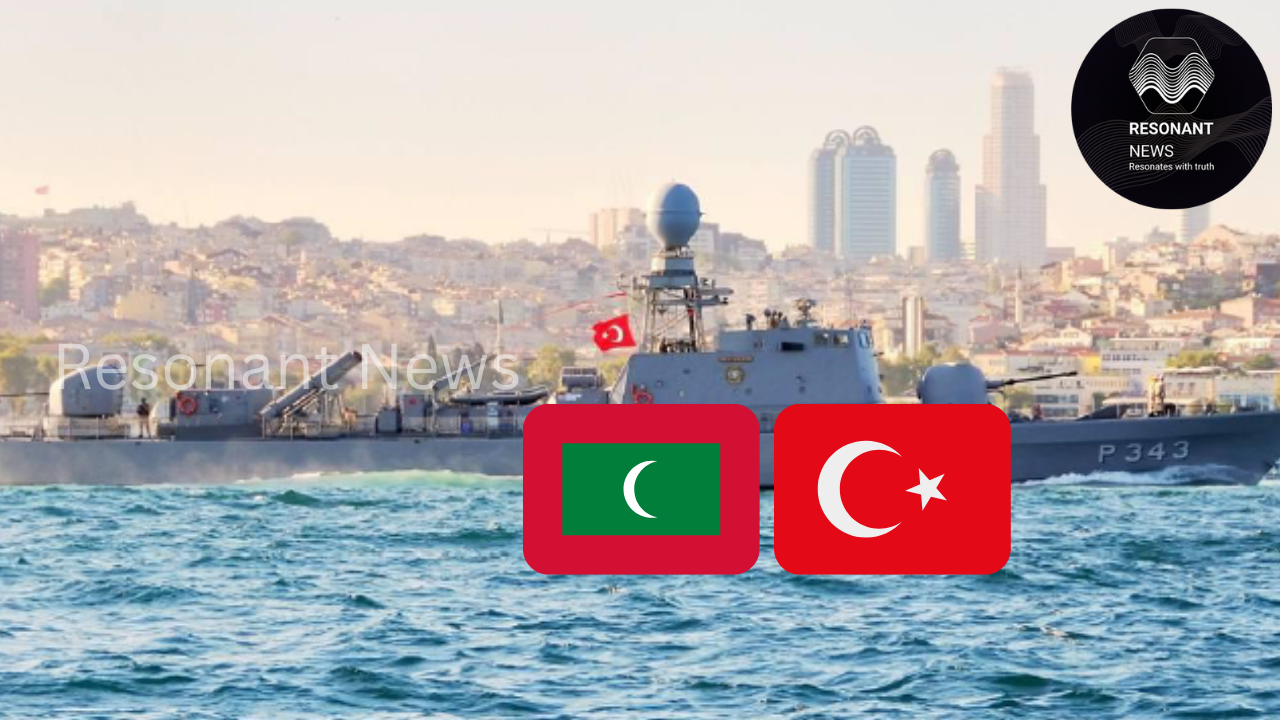

In a significant move to bolster defense ties, Turkey’s Ministry of Defense has announced the donation of the TCG Volkan (P-343), a Doğan-class fast attack craft, to the Maldivian Navy. The transfer, set to occur between April and June 2025, will see the vessel transported via a dock landing ship to the Maldives, where it will be commissioned by July.
A Turkish naval team will accompany the vessel to activate its systems and provide a two-week training program for Maldivian personnel, with training already underway in Turkey since April 7, 2025, and scheduled to conclude by May 9. This donation marks a deepening of Turkey-Maldives defense cooperation and has sparked strategic concerns for India, given the Maldives’ critical location in the Indian Ocean Region (IOR).
The TCG Volkan (P-343) is a Doğan-class fast attack craft, designed by German shipbuilder Lürssen Werft and commissioned into the Turkish Navy on May 12, 1981. As one of Turkey’s first vessels equipped with Harpoon anti-ship missiles, it represented a significant advancement in naval capabilities during its early years. Though reclassified in 2024 as a test and training vessel, the Volkan remains a capable platform for maritime operations. Key specifications include:
- Displacement: Approximately 436 tons, making it agile and suitable for rapid deployment.
- Dimensions: 58.1 meters in length, 7.6 meters in beam, and a draft of 2.7 meters.
- Propulsion: Powered by four MTU diesel engines, delivering a maximum speed of 36 knots (67 km/h).
- Range: Capable of traveling 1,050 nautical miles (1,944 km) at 30 knots, ideal for patrolling large maritime zones.
- Armament: Equipped with eight Harpoon anti-ship missiles, a 76mm Oto Melara naval gun, and two 35mm Oerlikon cannons, providing significant firepower for its size.
- Crew: Operated by a crew of 45, ensuring efficient handling of onboard systems.
- Electronics: Includes radar and fire control systems for missile and gun operations, though some systems may be outdated compared to modern vessels.
While the Volkan is over four decades old and less advanced than newer Turkish vessels like the Kılıç-class boats, it remains a robust platform for coastal defense and patrol missions. Its recent maintenance at Istanbul Naval Shipyard ensures operational readiness for its new role with the Maldivian Navy.
The transfer of TCG Volkan significantly enhances the Maldives’ maritime security capabilities, particularly given the nation’s vast Exclusive Economic Zone (EEZ) spanning over 900,000 square kilometers. The Maldives National Defence Force (MNDF) Coast Guard, tasked with patrolling this expansive area, has historically operated smaller vessels with limited firepower and range. The Volkan, as the largest and most heavily armed vessel in the MNDF’s fleet, offers several strategic advantages:
The Volkan’s speed (36 knots) and range (1,050 nautical miles) enable effective monitoring of the Maldives’ EEZ, combating illegal fishing, smuggling, and piracy, which are persistent challenges in the region. The Harpoon missiles and 76mm naval gun provide a credible deterrent against potential maritime threats, strengthening the Maldives’ ability to assert sovereignty over its waters. The vessel’s size and range make it suitable for humanitarian missions, such as disaster relief and search-and-rescue operations, critical in a nation vulnerable to climate change and rising sea levels. The accompanying Turkish training program will upskill Maldivian naval personnel, fostering greater operational independence and professionalism within the MNDF.
However, the vessel’s age raises concerns about maintenance costs, which could strain the Maldives’ limited defense budget. Critics have suggested that the donation may be tied to broader Turkish arms deals, including the Maldives’ planned purchase of 35 short-range surface-to-air missiles for approximately $32.4 million, potentially offsetting the “free” transfer’s financial benefits.
The transfer of TCG Volkan to the Maldives has significant implications for India, which views the Maldives as a critical partner in its maritime security architecture in the IOR. The Maldives’ proximity to India’s southern coast and its position along key shipping lanes make it a linchpin in India’s “Neighborhood First” policy and its efforts to counterbalance China’s growing influence in the region. Several factors highlight why this development is a concern for New Delhi:
Turkey’s donation of the Volkan, alongside other defense deals like drone sales and potential missile purchases, signals its intent to expand its strategic footprint in the IOR. This aligns with Turkey’s broader ambitions to project naval power into the Indian Ocean, as evidenced by its plans to build an aircraft carrier and destroyer capable of operating in the region. For India, Turkey’s growing ties with the Maldives, especially under President Mohamed Muizzu’s administration, which has pursued a pro-China and pro-Turkey foreign policy, challenge its traditional dominance in the Maldivian security sphere.

Leave a Reply