
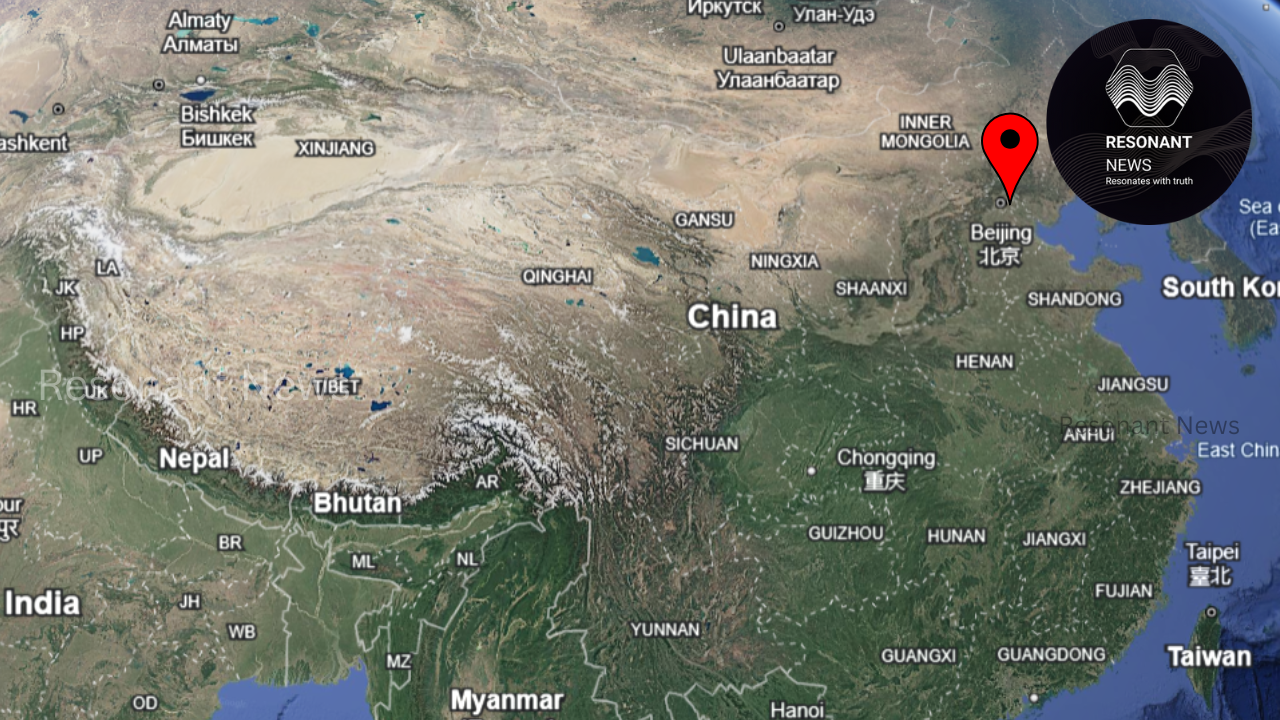

The Chinese People’s Liberation Army (PLA) recently released footage showcasing its advanced use of fiber-optic drones during training exercises, highlighting the technological strides made by the 194th Heavy Combined Arms Brigade under the 81st Group Army. Stationed in Xiyanhe Village, Jizhou District, Tianjin, this unit (designated as Unit 32134) demonstrated the drones’ capabilities in a broadcast by China Central Television (CCTV). These drones, which gained prominence during the Russia-Ukraine conflict, offer significant advantages in modern warfare due to their resistance to electronic interference. This article explores the deployment of fiber-optic drones by the PLA and delves into fascinating details about the 81st Group Army’s history, structure, and role in China’s military framework.

Fiber-optic drones represent a significant evolution in unmanned aerial vehicle (UAV) technology. Unlike traditional drones that rely on radio signals for communication, fiber-optic drones use a thin, lightweight cable to transmit data, making them immune to radio jamming and electronic warfare tactics. This ensures uninterrupted control and high-quality video feeds, critical for real-time battlefield decision-making. The technology gained attention during the Russia-Ukraine war, where drones played a pivotal role in reconnaissance and precision strikes.
However, the use of fiber-optic cables comes with trade-offs. The cable’s weight and the spool mechanism limit the drone’s payload capacity, reducing its range, flight time, and maneuverability compared to radio-controlled counterparts. Despite these constraints, the PLA’s adoption of this technology underscores its focus on countering electronic warfare threats, a growing concern in modern conflicts. The training footage from the 194th Heavy Combined Arms Brigade illustrates how these drones are integrated into exercises targeting simulated enemy armored vehicles, showcasing their potential in coordinated assaults.

The 81st Group Army: A Pillar of the PLA’s Central Theater Command
The 81st Group Army, formerly known as the 65th Group Army, is a key formation within the PLA Ground Forces (PLAGF), operating under the Central Theater Command. Headquartered in Zhangjiakou, Hebei Province, it is one of thirteen group armies in the PLA, responsible for defending critical regions, including Beijing and Tianjin. Below are some intriguing facts about the 81st Group Army, shedding light on its history, structure, and strategic importance:
- The 81st Group Army traces its origins to the 5th Column of the North China Field Army, established around 1946 during the Chinese Civil War. Reorganized in 1949 as the 65th Army, it comprised the 193rd, 194th, and 195th Divisions and saw action in the Korean War (1951–1953).
- In 2017, as part of a major PLA reorganization, the 65th Group Army was redesignated as the 81st Group Army, reflecting a shift toward a more flexible, brigade-centric structure. This reform reduced the number of group armies from 18 to 13, aligning them with five new theater commands.
- The 81st Group Army oversees a diverse array of units, including the 70th Light, 162nd and 189th Medium, and 7th, 194th, and 195th Heavy Combined Arms Brigades, alongside specialized brigades for artillery, air defense, special forces, army aviation, engineering, and support.
- The 194th Heavy Combined Arms Brigade, featured in the drone footage, is equipped with advanced Type 99 tanks and Type 04/04A infantry fighting vehicles, emphasizing armored warfare capabilities. The 195th Heavy Combined Arms Brigade serves as a dedicated “blue force” unit, simulating enemy tactics during exercises to enhance training realism.
- The 81st Army Aviation Brigade operates helicopters such as the Z-8, Z-9, Z-10, Z-19, and the modern Z-20, enhancing air mobility and support for ground operations.
- Stationed in the Central Theater Command, the 81st Group Army is tasked with safeguarding Beijing and serving as a general reserve for national defense. Its proximity to the capital underscores its role in both internal security and external defense.
- Recent training exercises, such as the fortified area assault drill conducted by an unidentified Heavy Combined Arms Brigade under the 81st Group Army, showcased the integration of Type 99A tanks with anti-drone “cope cages,” Type 04A infantry fighting vehicles, and fiber-optic drones. These drills emphasize multi-domain operations, combining armored units, infantry, engineering vehicles, and UAVs to counter evolving battlefield threats.
- The adoption of fiber-optic drones by the 194th Heavy Combined Arms Brigade highlights the PLA’s emphasis on technological innovation. Posts on X indicate that these drones were developed in response to electronic warfare interference encountered in previous exercises, demonstrating the PLA’s adaptability to modern challenges.
- The 81st Group Army’s use of advanced equipment, such as the Type 99 tanks and HQ-16/17 air defense systems, reflects its role as a testing ground for cutting-edge military technologies within the PLA.
- The 81st Group Army, then known as the 65th Group Army, was involved in the 1989 Tiananmen Square protests, where its 193rd and 194th Infantry Divisions were deployed to enforce martial law in Beijing. This historical involvement remains a sensitive topic in China’s military history.
The PLA’s integration of fiber-optic drones into the 81st Group Army’s training reflects a broader strategy to enhance resilience against electronic warfare, a critical factor in contemporary conflicts. The footage from Xiyanhe Village illustrates how these drones are employed to strike armored targets, likely simulating scenarios where electronic jamming could disrupt conventional drone operations. By equipping units like the 194th Heavy Combined Arms Brigade with such technology, the PLA aims to maintain operational effectiveness in contested environments, drawing lessons from conflicts like the Russia-Ukraine war.

Moreover, the 81st Group Army’s focus on multi-domain operations—integrating drones, armored units, and specialized engineering vehicles—demonstrates a shift toward more sophisticated, networked warfare. The use of UAVs to lay smoke curtains and provide situational awareness, as seen in recent drills, enhances the brigade’s ability to execute complex maneuvers while minimizing exposure to enemy defenses.

Leave a Reply