
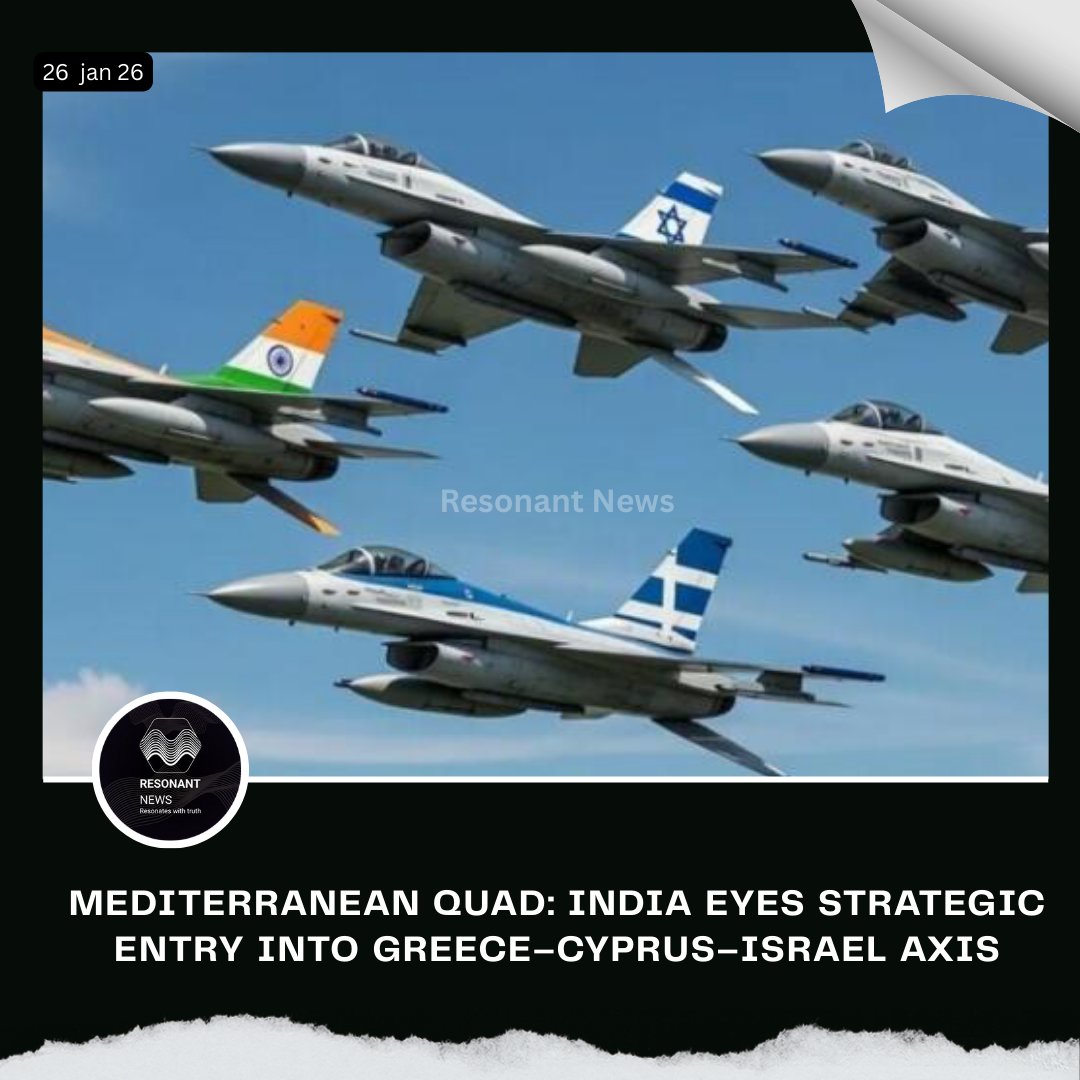

The invitation for India to join the existing Greece–Cyprus–Israel trilateral framework—often referred to as the “3+1” format (with the United States as the +1)—has sparked significant interest in strategic and defense circles. Analysts suggest this could evolve into a “Mediterranean Quad” (or MedQUAD), potentially serving as a counterbalance to Turkey’s increasing assertiveness in the Eastern Mediterranean and emerging alignments sometimes labeled an “Islamic NATO” involving Turkey, Pakistan, and Saudi Arabia.
Greece, Cyprus, and Israel have long cooperated in defense and security domains, including joint naval and air exercises, unmanned systems development, electronic warfare capabilities, and maritime security operations. Recent developments, such as the signing of a 2026 Trilateral Military Cooperation Plan in late December 2025, have deepened these ties, with a focus on specialized training and strategic dialogue to promote regional stability.
A formal invitation has reportedly been extended to India to participate in “3+1” summits and strategic forums. This aligns well with New Delhi’s established relationships: longstanding defense and technology partnerships with Israel, growing military and maritime cooperation with Greece, and expanding high-level engagements with Cyprus.
Participation would offer India strategic advantages, including enhanced protection for key initiatives like the India-Middle East-Europe Economic Corridor (IMEC), which aims to connect India to Europe via the Middle East through sea and rail routes, bypassing certain regional chokepoints. It could also bolster India’s westward strategic footprint, opening new avenues for influence in Mediterranean energy security, trade routes, and broader geopolitical balancing.
While no official confirmation of India’s full integration into the grouping has been made, the proposal is generating active discussion in Greek, Israeli, and Indian defense and strategic communities. If realized, experts argue it would significantly elevate India’s role in the Eastern Mediterranean security architecture, positioning New Delhi as a pivotal player amid shifting regional dynamics.
For now, the idea remains in the analytical and exploratory stage, but its traction underscores the evolving nature of global alliances in response to emerging threats and opportunities.

Leave a Reply