
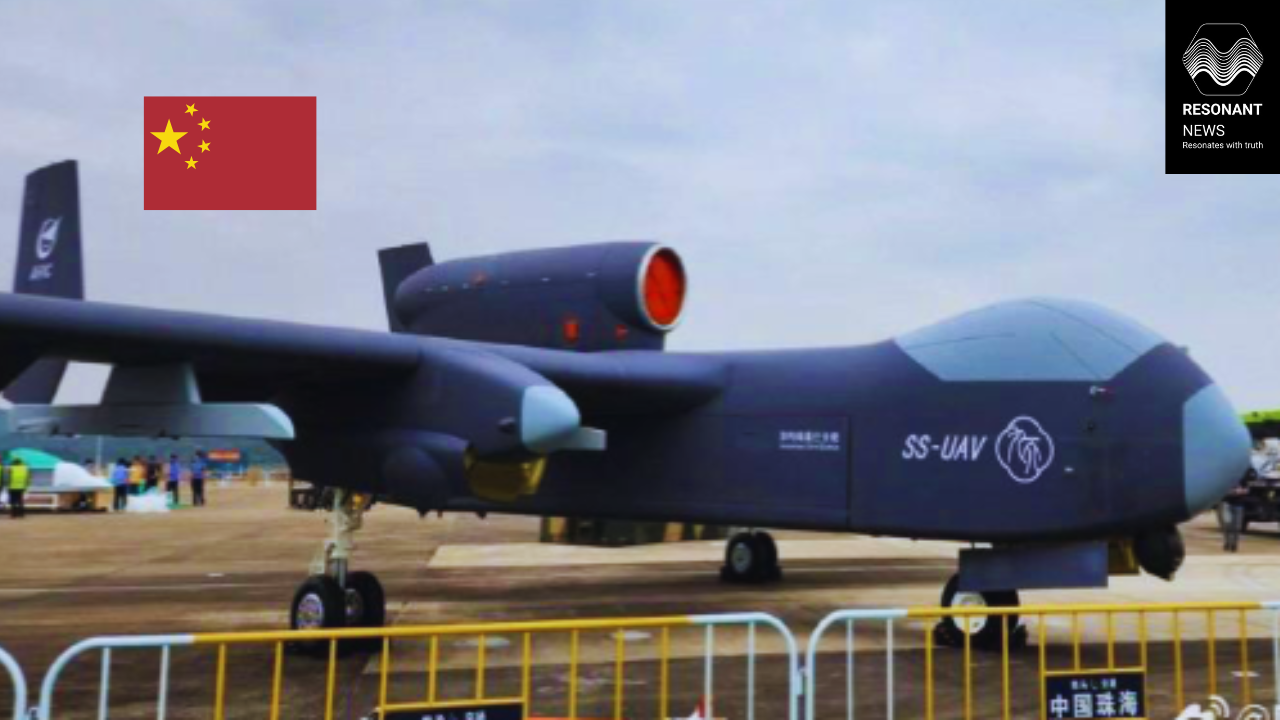

The Jiutian UAV, in addition to its primary reconnaissance capabilities, is designed to support significant payload flexibility, including bomb-carrying configurations.
- Wing-Mounted Suspension Points: The platform integrates eight suspension points along the wing structure, facilitating various payload configurations.
- Internal Payload Bay: It features an internal compartment capable of housing kamikaze drones, offering enhanced mission versatility.
A key innovation in the Jiutian UAV is its “heterogeneous honeycomb mission bay”—an advanced modular system enabling the release of multiple auxiliary drones during flight. Ostensibly, this capability is optimized for saturation or electronic disruption operations, supporting prolonged surveillance and autonomous precision targeting. According to China’s claim, Jiutian’s mission bay represents a pioneering development in large-scale UAV architecture, extending its operational roles beyond surveillance into swarm-based tactical applications, which significantly augment its tactical efficacy and adaptability.

PLA forces claim the design philosophy enables the projection of a persistent air presence, serving as a strategic deterrent and providing real-time reconnaissance capabilities with rapid strike readiness upon target identification.
Engineered by the Aviation Industry Corporation of China (AVIC), the SS-UAV features a single-engine configuration, a substantial wingspan, and a fuselage outfitted with eight underwing pylons, allowing for diverse payload deployment—including high-resolution sensors and potential weapon systems. With dimensions comparable to the B-25 or H-5, the Jiutian integrates a central modular mission bay, enhancing its operational flexibility and facilitating rapid reconfiguration to meet specific reconnaissance or strike mission profiles.

Leave a Reply