
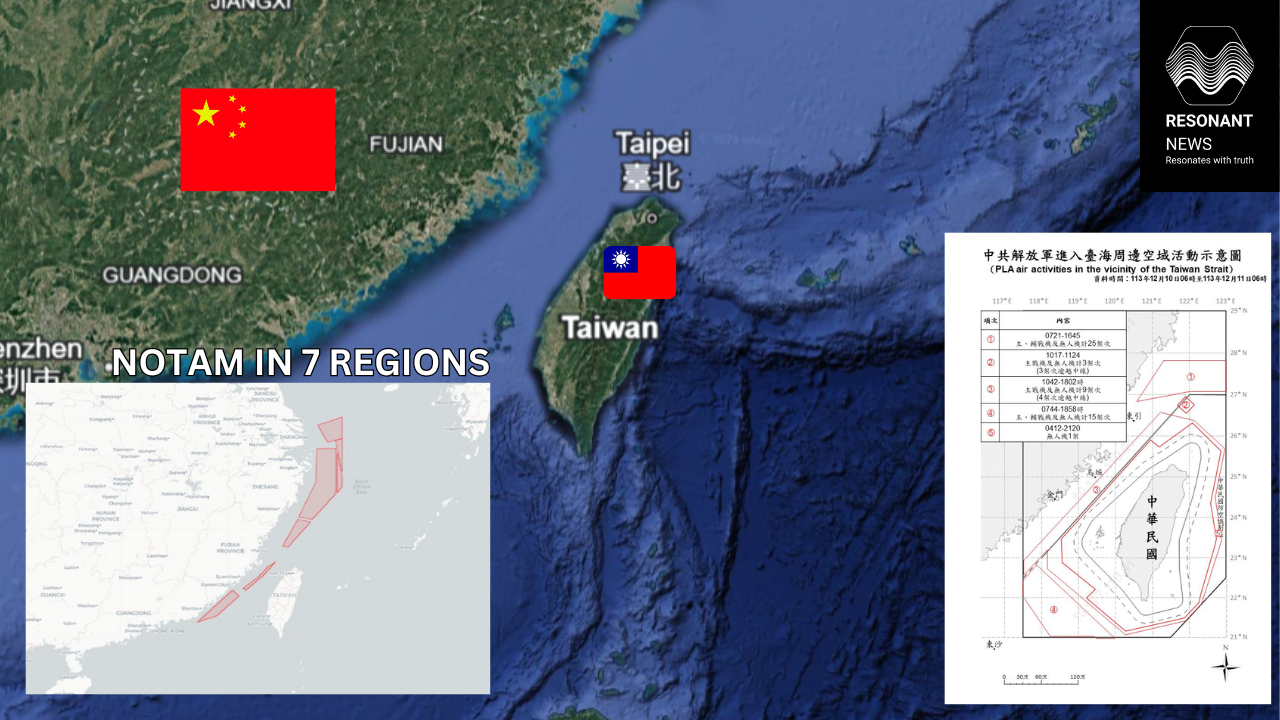

On 9th China declared NOTAM in 7 regions between China and Taiwan– in the sea. Taiwanese authorities soon reported that China has escalated military exercises around the island, describing them as an effort to establish a strategic “red line” for the incoming U.S. administration. They labeled Beijing a “destabilizing actor.” Albeit some do believe that China is targeting the first island chain.
These extensive maritime drills, reportedly the largest in years, involve approximately 60 warships and 30 coast guard vessels operating from the southern Japanese islands to the South China Sea. Additionally, China’s military aircraft activity near Taiwan has intensified, with the island’s defense ministry recording 100 sorties over the past 48 hours.
Beijing has not issued any formal announcements, nor has Chinese state media commented on heightened military operations in the East China Sea, Taiwan Strait, South China Sea, or Western Pacific.
During a recent Pacific tour by Taiwanese President Lai Ching-te, which included two stops in U.S. territories, Beijing expressed clearly that it was irked, reiterating its claim over Taiwan as part of China’s territory.
Beijing’s large-scale maritime exercises, planned since October, aim to demonstrate its capability to blockade Taiwan and to “set a red line” ahead of the next U.S. administration. Some say that China is using President Lai’s overseas visit as a pretext, with Taiwan serving merely as a justification for broader strategic objectives. These include asserting dominance within the first island chain and reinforcing strategic deterrence in anticipation of the U.S. presidential transition.

(US flags show US bases and contingents in the region)
The First island Chain
The first island chain refers to a strategically significant series of Pacific archipelagos extending outward from East Asia’s continental mainland. This chain primarily includes the Kuril Islands, the Japanese archipelago, the Ryukyu Islands, Taiwan (Formosa), the northern Philippines, and Borneo, forming a sweeping arc from the Kamchatka Peninsula in the northeast to the Malay Peninsula in the southwest.
As part of the U.S. island chain strategy, the first island chain serves as a geopolitical barrier, anchoring the United States’ forward-deployed posture in the Indo-Pacific and contributing to its ability to project power and contain adversarial expansion. It is a central element of the broader “island chain doctrine,” which also includes the second and third island chains farther east.
A significant portion of the first island chain overlaps with waters claimed by China under the contentious nine-dash line, encompassing much of the South China Sea. Additionally, parts of the chain align with China’s contested claims in the East China Sea, particularly west of the Okinawa Trough. These overlapping claims amplify the strategic importance of the first island chain in regional geopolitics, highlighting its role as a flashpoint in U.S.-China strategic competition.
Interesting fact: The first island chain is not merely a theoretical concept but a practical framework influencing military operations, trade routes, and regional alliances. For example, Taiwan’s central location within the chain underscores its pivotal role in maintaining a free and open Indo-Pacific.
Taiwan’s Ministry of Foreign Affairs characterized the increased military maneuvers, including extensive naval drills and frequent aircraft deployments, as evidence of China’s role as a “troublemaker.”
Meanwhile, U.S. Defense Secretary Lloyd Austin affirmed that the United States is closely monitoring China’s activities and remains committed to maintaining stability in the Taiwan Strait. “Our policy remains unchanged. We will continue supporting Taiwan in acquiring the necessary means to defend itself,” Austin stated during a press briefing at a U.S. base in Japan.

Leave a Reply