
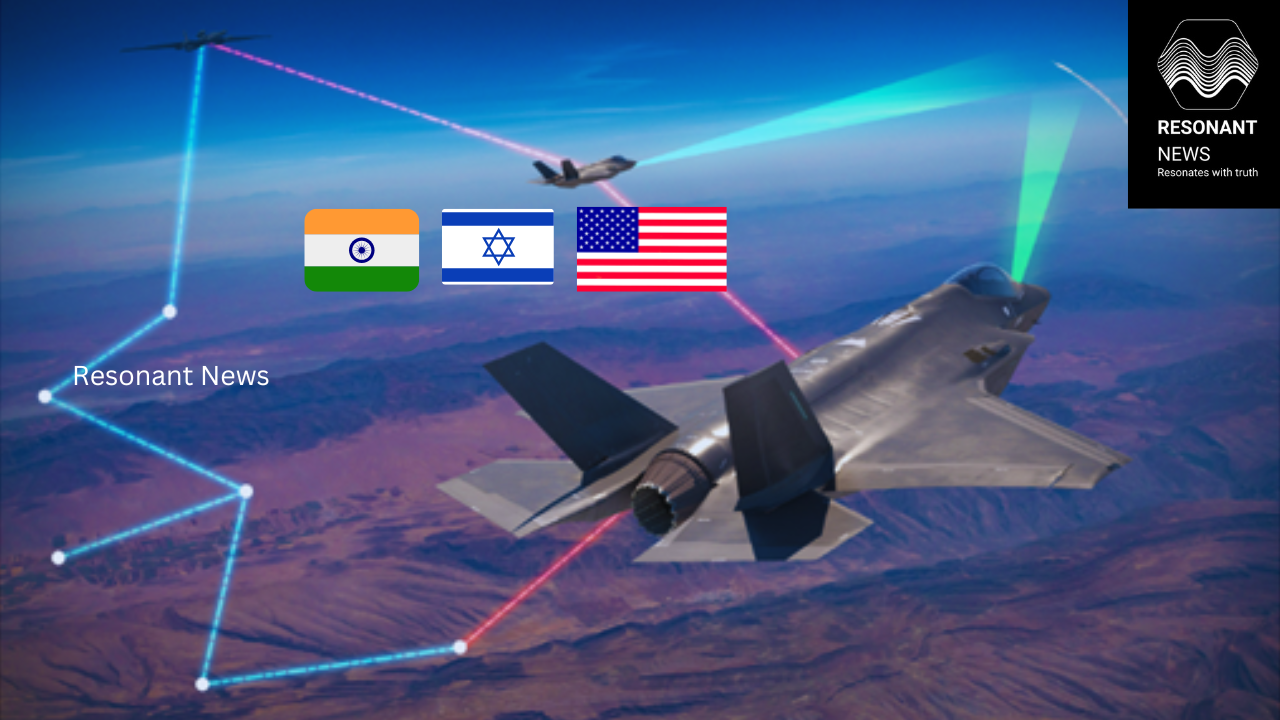

The F-35 Lightning II stands as a pinnacle of modern military aviation, embodying cutting-edge technology and unparalleled capabilities. Designed to meet the diverse needs of various armed forces, this fifth-generation multirole fighter jet seamlessly integrates stealth, advanced sensors, and supersonic performance.
Standout Technologies of the F-35
At the heart of the F-35’s superiority is its stealth design. The aircraft’s airframe is meticulously crafted to minimize radar cross-section, allowing it to operate undetected in hostile environments. This stealth capability is complemented by advanced materials and coatings that further reduce its visibility to enemy radar systems. The F-35 is equipped with the AN/APG-81 Active Electronically Scanned Array (AESA) radar, which offers comprehensive battlefield surveillance and target acquisition. This radar system works in harmony with the Distributed Aperture System (DAS), a network of infrared sensors providing 360-degree situational awareness, alerting pilots to incoming threats, and enhancing navigation in low-visibility conditions. Another notable feature is the Electro-Optical Targeting System (EOTS), integrated seamlessly into the aircraft’s fuselage. EOTS combines forward-looking infrared and laser targeting capabilities, enabling precision engagement of ground and aerial targets. This system ensures that pilots can identify, track, and neutralize threats with pinpoint accuracy. The F-35’s sensor fusion technology amalgamates data from its myriad sensors, presenting pilots with a unified and coherent operational picture. This integration reduces pilot workload and enhances decision-making speed and effectiveness. Coupled with the advanced helmet-mounted display system, pilots receive real-time data directly onto their visors, allowing them to remain focused on mission objectives without the need to glance down at traditional cockpit displays.
Specifications of the F-35
The F-35 family comprises three primary variants, each tailored to specific operational requirements: –
F-35A: Designed for conventional takeoff and landing (CTOL), the F-35A serves as the standard variant for the U.S. Air Force and allied nations. It boasts a top speed of Mach 1.6 and a combat radius exceeding 1,000 kilometers, making it adept at both air-to-air and air-to-ground missions.
F-35B: This variant features short takeoff and vertical landing (STOVL) capabilities, making it ideal for operations from amphibious assault ships and austere airfields. The F-35B’s versatility ensures that it can operate in environments where traditional runways are unavailable.
F-35C: Tailored for aircraft carrier operations, the F-35C comes equipped with larger wings and reinforced landing gear to withstand the rigors of catapult launches and arrested landings. Its design ensures extended range and durability, essential for naval missions.
All variants are powered by the Pratt & Whitney F135 engine, delivering robust thrust and enabling the aircraft to achieve supersonic speeds without afterburner—a feature known as “supercruise.” The internal weapons bays of the F-35 allow it to carry a diverse array of munitions while maintaining its stealth profile. Additionally, the aircraft’s advanced avionics and communication systems ensure seamless interoperability with other platforms, enhancing joint operational effectiveness.
Transfer of Technology to India: An Unlikely Prospect
The prospect of transferring F-35 technology to India faces significant challenges. One primary concern is the protection of sensitive technologies integral to the F-35’s capabilities. The U.S. government exercises stringent controls over the dissemination of such technologies to safeguard national security interests and maintain a strategic edge over potential adversaries. Moreover, India’s historical defense procurement patterns have leaned heavily towards Russian equipment. This existing inventory presents compatibility challenges, as integrating F-35s into a predominantly Russian-equipped force would require substantial logistical adjustments and infrastructure overhauls. The financial implications of such an integration are considerable, encompassing not only the acquisition costs but also the long-term maintenance and training expenditures. Political dynamics further complicate the scenario. The U.S. has, on occasion, imposed sanctions or restrictions on nations engaging in defense collaborations with countries it views with suspicion. India’s ongoing defense relationships with Russia could potentially trigger such responses, adding a layer of geopolitical complexity to any potential F-35 deal.
Centralised Control
The F-35’s maintenance, mission planning, and logistics are managed through a cloud-based system—originally ALIS, now transitioning to ODIN. – This system is controlled by Lockheed Martin and the US Department of Defense, meaning every operational detail hinges on American oversight.
Operational Delays Among Allies: – Even close US allies like Australia and the UK have experienced delays in receiving ALIS approvals, which raises serious questions about the level of operational independence that can be achieved.
Israel’s Experience
Israel’s F-35 variant, known as “Adir,” benefits from some flexibility compared to other operators. Despite its customizations, it still relies on ALIS for essential maintenance and operational functions, illustrating that no country, not even strategic partners, can gain complete autonomy over the F-35’s logistical ecosystem.
Implications for India
If India were to acquire the F-35, its air force operations would be irrevocably tied to American control through this logistics system. This dependency would limit India’s operational independence and decision-making capabilities.
Weapons Systems Dependency
The F-35 is deeply integrated with American weapons, specifically designed to operate with AIM-120 AMRAAMs for beyond-visual-range combat. – For India, this would necessitate a significant overhaul of its missile inventory, as the aircraft would require US-standard weapons.
Limitations on Weapon Integration
Unlike platforms such as the Su-30MKI—which was modified to carry BrahMos—or the Rafale, which utilizes Meteor and SCALP, the F-35 demands explicit US approval to integrate any missile systems that fall outside NATO standards. – This constraint could significantly restrict India’s ability to deploy either indigenous or foreign weapon systems on the F-35.
Classified Systems and Software Restrictions
The mission systems, electronic warfare suite, and flight software of the F-35 are entirely classified and locked by the US. – This means that any modifications or upgrades to these systems would require explicit American approval, further entrenching the reliance on US control.
Overall Implication
The tight coupling of the F-35 with the US ecosystem—from logistics and maintenance to weapons systems and software—presents a significant disadvantage for countries seeking independent operational control. For us in India, this would mean a permanent and deep-seated dependency on American oversight, posing a major strategic challenge in terms of autonomy and flexibility.

Leave a Reply