
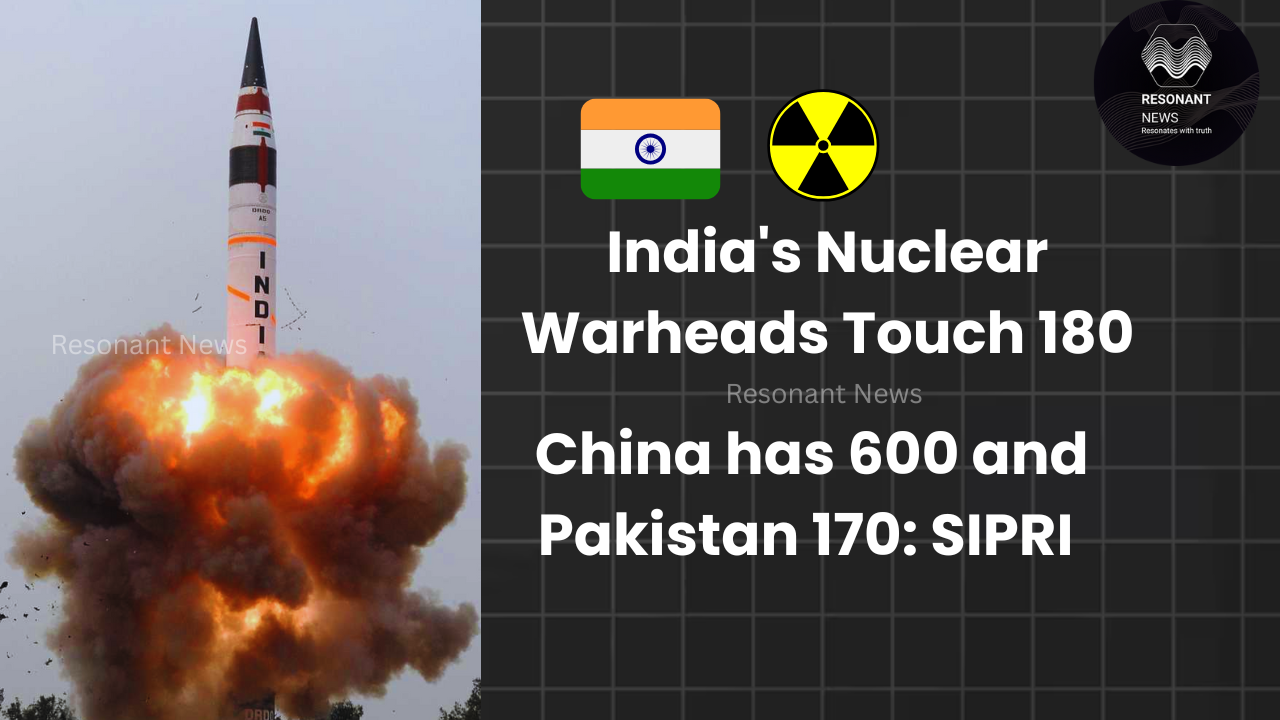

In 2024, India and Pakistan continued to enhance their nuclear arsenals, focusing on diversifying delivery systems and improving strategic capabilities. Both nations pursued the development of multiple warhead ballistic missiles, with India expanding its nuclear triad and Pakistan countering regional missile defense advancements. This article explores the latest developments in their nuclear programs, including stockpile estimates, delivery systems, and strategic shifts, as of January 2025.
As per latest SIPRi report, India’s nuclear arsenal is estimated at approximately 180 warheads as of January 2025, reflecting a modest increase from the previous year. China currently has at least 600 nuclear warheads and Pakistan 170. These weapons are integrated into a maturing nuclear triad comprising aircraft, land-based missiles, and submarine-launched ballistic missiles (SLBMs).
Historically, India has stored nuclear warheads separately from launchers during peacetime. However, recent developments suggest a potential shift toward mating warheads with launchers. The use of canisterized missiles and sea-based deterrence patrols by nuclear-powered ballistic missile submarines (SSBNs) indicate a move toward greater readiness.
India is advancing its missile technology, particularly with the Agni-V intermediate-range ballistic missile (IRBM), which is designed to carry multiple independently targetable reentry vehicles (MIRVs). In March 2024, India successfully conducted Mission Divyastra, the first flight test of the MIRV-capable Agni-V, enhancing its ability to strike multiple targets with a single missile. Additionally, India is developing the Agni-VI IRBM and the Agni-P intercontinental ballistic missile (ICBM), both aimed at extending its strategic reach, particularly toward China. The short-range Prithvi missile and other nuclear-capable missiles are considered dual-capable, able to carry both conventional and nuclear warheads.
India is bolstering its sea-based nuclear deterrent with a fleet of four to six SSBNs. The first SSBN, INS Arihant, completed its initial deterrence patrol in 2018, while the second, INS Arighaat, was commissioned in August 2024 after delays. Each submarine is equipped with a four-tube vertical-launch system capable of carrying up to 12 K-15 SLBMs. The Stockholm International Peace Research Institute (SIPRI) estimates that 12 nuclear warheads are allocated to INS Arihant and another 12 to INS Arighaat.
A third SSBN, provisionally named S4, is larger, with eight missile tubes, and a next-generation S5 class is in the design phase. India is also developing the K-4 SLBM, which will further enhance its naval nuclear capabilities.
India is pursuing dual-use hypersonic cruise missiles as part of its broader missile development efforts, aligning with global trends in advanced weaponry. These missiles could serve both conventional and nuclear roles, enhancing India’s strategic flexibility.
India’s 1998 nuclear tests demonstrated yields of up to 12 kilotons (kt). While there is speculation that boosted warheads with yields up to 40 kt may have been developed, there is no open-source evidence confirming the development of two-stage thermonuclear warheads.
Pakistan’s Nuclear Developments
Pakistan’s nuclear stockpile is estimated to remain stable at around 170 warheads as of January 2025. The country continues to develop a nascent nuclear triad comprising aircraft, ground-launched ballistic and cruise missiles, and sea-launched cruise missiles (SLCMs).
Pakistan is focusing on countering India’s advanced ballistic missile defenses, particularly the Russian-supplied S-400 system. The Ababeel medium-range ballistic missile, reportedly capable of delivering MIRVs, is under development but was not operationally deployed as of January 2025. This program is likely a response to India’s missile defense capabilities, aiming to ensure Pakistan’s deterrent remains effective.
Pakistan is working to establish a sea-based nuclear force to achieve a secure second-strike capability. The Babur-3 SLCM, test-launched in 2017 and 2018, is intended for deployment on the Pakistan Navy’s three Agosta-90B diesel-electric submarines. This development aims to enhance Pakistan’s nuclear triad and ensure survivability in a conflict scenario.
Pakistan’s ongoing accumulation of fissile material and development of new delivery systems suggest that its nuclear arsenal and fissile material stockpile will likely expand over the next decade. However, projections vary due to limited publicly available data.
Strategic Implications
India’s nuclear posture increasingly focuses on China, with longer-range missiles like the Agni-V and Agni-P designed to reach targets across Chinese territory. Meanwhile, Pakistan remains the primary focus of India’s nuclear deterrent, though its advancements also serve as a hedge against regional rivals. Pakistan’s pursuit of MIRV technology and sea-based capabilities reflects its need to counter India’s growing missile defense systems and maintain a credible deterrent.
Both nations’ development of dual-capable missiles and hypersonic technologies highlights the increasing complexity of their nuclear strategies. The shift toward MIRV-capable missiles and sea-based deterrents suggests a move toward more robust and flexible nuclear postures, raising concerns about regional stability and the potential for escalation.
India’s maturing triad, MIRV-capable missiles, and expanding SSBN fleet position it as a significant nuclear power with ambitions beyond Indian subcontinent.
SIPRI estimated the total global nuclear warhead inventory at 12,241, of which about 9,614 were in military stockpiles for potential use. Around 3,912 warheads were deployed with operational missiles and aircraft, and the rest remained in central storage.

Leave a Reply