
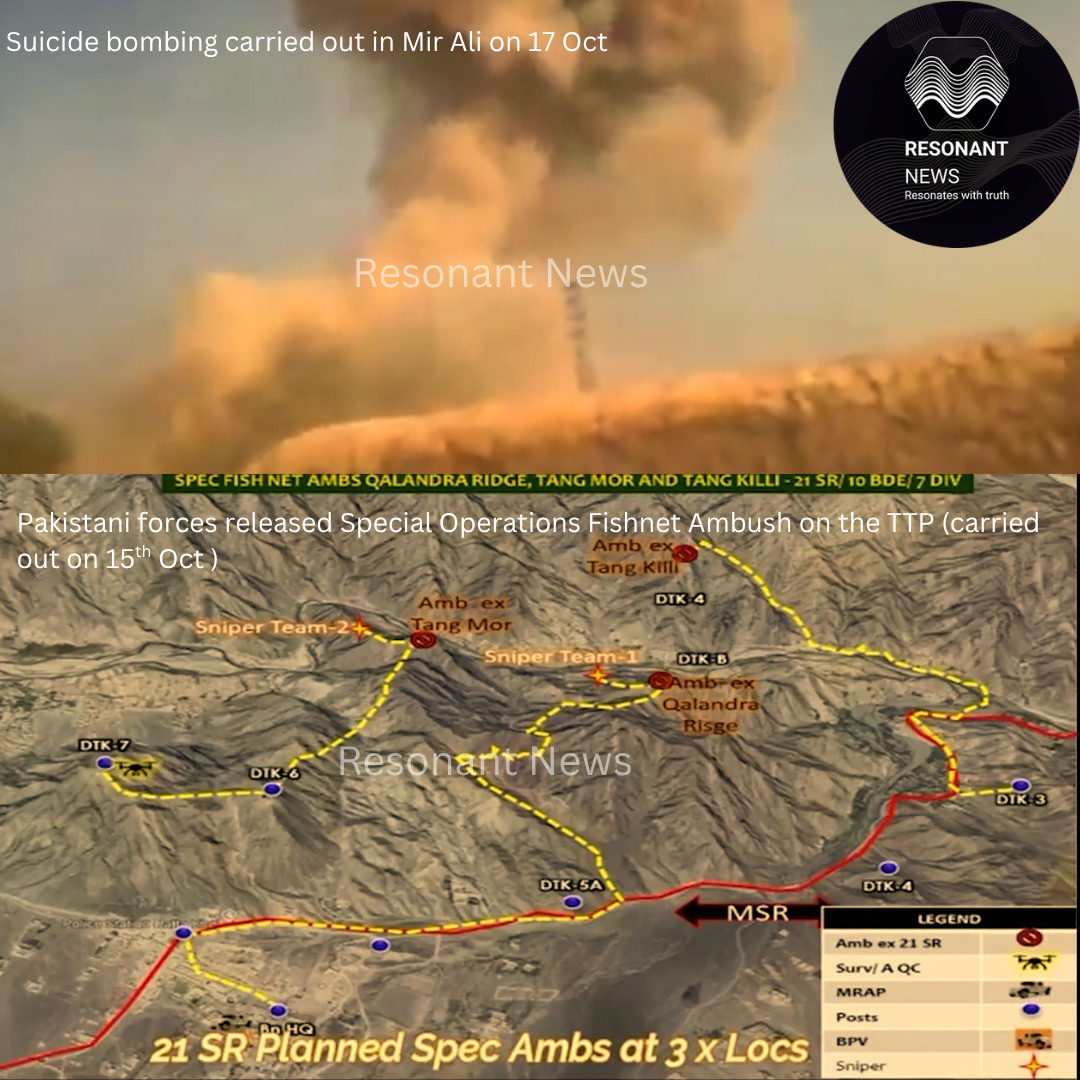
The recent suicide bombing in Mir Ali, North Waziristan, this morning on October 17, 2025, has once again exposed the fragility of the ceasefire along the Afghanistan-Pakistan border, underscoring Pakistan’s ongoing struggles with internal security and its strained relations with Kabul. Reports indicate that a suicide attacker rammed an explosive-laden vehicle into a Pakistani security forces camp, resulting in the deaths of at least six Pakistani soldiers and injuring several others, despite Islamabad’s claims of having “foiled” the assault by eliminating four militants. This incident, attributed to Tehreek-e-Taliban Pakistan (TTP) operatives, comes amid heightened tensions following the deadly clashes along the Durand Line earlier this month, highlighting how Pakistan’s aggressive policies towards Afghanistan continue to backfire, fueling militancy within its own borders.
Video of attack in Mir Ali (17 Oct)
From India’s vantage point, these developments reaffirm the wisdom of New Delhi’s strategic outreach to the Taliban-led government in Kabul, as evidenced by the successful visit of Acting Foreign Minister Amir Khan Muttaqi from October 9 to 16. As an Indian observer, it’s heartening to see Afghanistan seeking diversified partnerships beyond its historically turbulent ties with Pakistan, which have often been marred by Islamabad’s duplicitous support for terrorist groups. The October 11-12 overnight skirmishes along the 2,640-km Durand Line—triggered by Pakistan’s reckless airstrike in Kabul on October 9—serve as a stark reminder of how Pakistan’s unilateral actions threaten regional stability, particularly when they masquerade as counter-terrorism but end up slaughtering innocent civilians.
Pakistan’s October 9 strike, ostensibly aimed at TTP chief Noor Wali Mehsud, instead devastated a bustling civilian market in Kabul, claiming at least 15 non-combatant lives. Mehsud himself debunked Islamabad’s claims in a statement on October 16, asserting he was unharmed and labeling the attack as a blatant violation of Afghan sovereignty. This provocation ignited a chain of artillery barrages, drone assaults, and ground incursions, primarily in Afghanistan’s Kunar and Paktika provinces, with fallout spilling into Pakistan’s Bajaur and Khyber districts. By October 12 dawn, satellite images revealed smoldering outposts and breached fencing, while key trade routes like Torkham and Spin Boldak—vital for over $2.5 billion in annual bilateral trade—ground to a halt, stranding traders and exacerbating economic woes in both nations. A tenuous ceasefire, brokered by Saudi Arabia and Qatar on October 13, offered brief respite, but today’s Mir Ali blast proves how quickly such truces can unravel, especially when Pakistan refuses to address the root causes of cross-border militancy.
Islamabad’s narrative paints its operations as “defensive” against “unprovoked Taliban aggression,” boasting of neutralizing over 200 Taliban and TTP fighters, destroying 21 Afghan positions, and dismantling terrorist camps. They reported 23 Pakistani security personnel killed and 29 injured. Pakistan even summoned the Afghan ambassador, denied airspace violations, and invoked UN Charter Article 51 for self-defense. Yet, from an Indian perspective, this reeks of hypocrisy—Pakistan has long harbored and sponsored groups like the Islamic State-Khorasan Province (IS-KP) to destabilize Afghanistan, as repeatedly alleged by Taliban officials. Zabihullah Mujahid, the Taliban spokesperson, has warned that IS-KP operatives are funneled through Pakistani hubs like Karachi and Islamabad, with no real Afghan territory under their control.
In 2025 alone, up to October 12, IS-KP launched 11 attacks in Afghanistan, killing two civilians and 35 Taliban members, a drop from 2024’s 24 attacks that claimed 135 civilian and 22 Taliban lives. Kabul’s intelligence chief Abdul Haq Wasiq has rightly called out “foreign powers”—clearly implying Pakistan—for exporting terrorism.
In contrast, the Taliban in Kabul framed the clashes as righteous self-defense against Pakistani imperialism, rejecting the Durand Line as a colonial relic. They claimed to have eliminated 58 Pakistani soldiers with only nine losses on their side, and local Pashtun reports suggest brief overruns of Pakistani posts. This assertiveness aligns with Afghanistan’s pivot towards reliable partners like India, where Muttaqi’s visit yielded concrete gains: upgrading India’s Kabul mission to full embassy status, reopening $500 million humanitarian aid channels, and exploring $3 billion investments via Iran’s Chabahar Port to sidestep Pakistani routes. At a New Delhi press conference on October 12, Muttaqi lambasted Pakistan’s “rogue elements” for nurturing IS-KP networks and vowed to protect Afghan sovereignty. Pakistan’s furious response—accusing India of manipulating Kabul and expelling Afghan diplomats—only isolates Islamabad further, revealing its discomfort with a multipolar South Asia where India plays a stabilizing role.
Historically, Afghanistan-Pakistan border flare-ups trace back to 2007, with at least 39 incidents up to October 10, 2025, per South Asia Terrorism Portal data, causing 60 Pakistani deaths (41 security forces, 19 civilians). Pakistan’s near-complete border fence, a $500 million project, has fueled Afghan resentment, leading to 16 clashes in 2024 alone (eight Pakistani deaths, 24 injured) and 12 in the first nine months of 2025 (three Pakistani security fatalities, nine injured). The Taliban’s 2021 resurgence has spiked encounters by 25%, intertwined with surging TTP infiltrations from Afghan soil—17 attempts in 2025 up to October 10, killing 202 (mostly militants) and injuring 33. While Pakistan blames Kabul for TTP safe havens, India views this as blowback from Islamabad’s own proxy games, which have cost $300 million in trade losses from Torkham closures this year.
Saudi and Qatari mediation, leveraging financial leverage like $1.5 billion bailouts and Hajj logistics, averted wider war, with proposals for joint border monitoring. But from Indian pov, this is a temporary band-aid; true peace demands Pakistan dismantle its terror infrastructure, including IS-KP support, and engage in sincere dialogue on the Durand Line. The UN reports 5,000 displaced Pashtuns from the October clashes, eroding trust further. Muttaqi’s New Delhi visit marks a geopolitical shift, offering Afghanistan independence from Pakistani dominance and boosting India’s regional influence through aid and trade.
Today’s Mir Ali attack, amid TTP’s surge post-Muttaqi’s India trip, signals escalating proxy wars that could engulf South Asia. Pakistan, once the Taliban’s patron, now faces open hostility from Kabul, risking broader instability. As Muttaqi aptly stated in Delhi, “Afghanistan craves peace first—but its resolve is eternal.” India stands ready to support that resolve, promoting dialogue and development over Islamabad’s aggression, for a more secure neighborhood.

Leave a Reply