
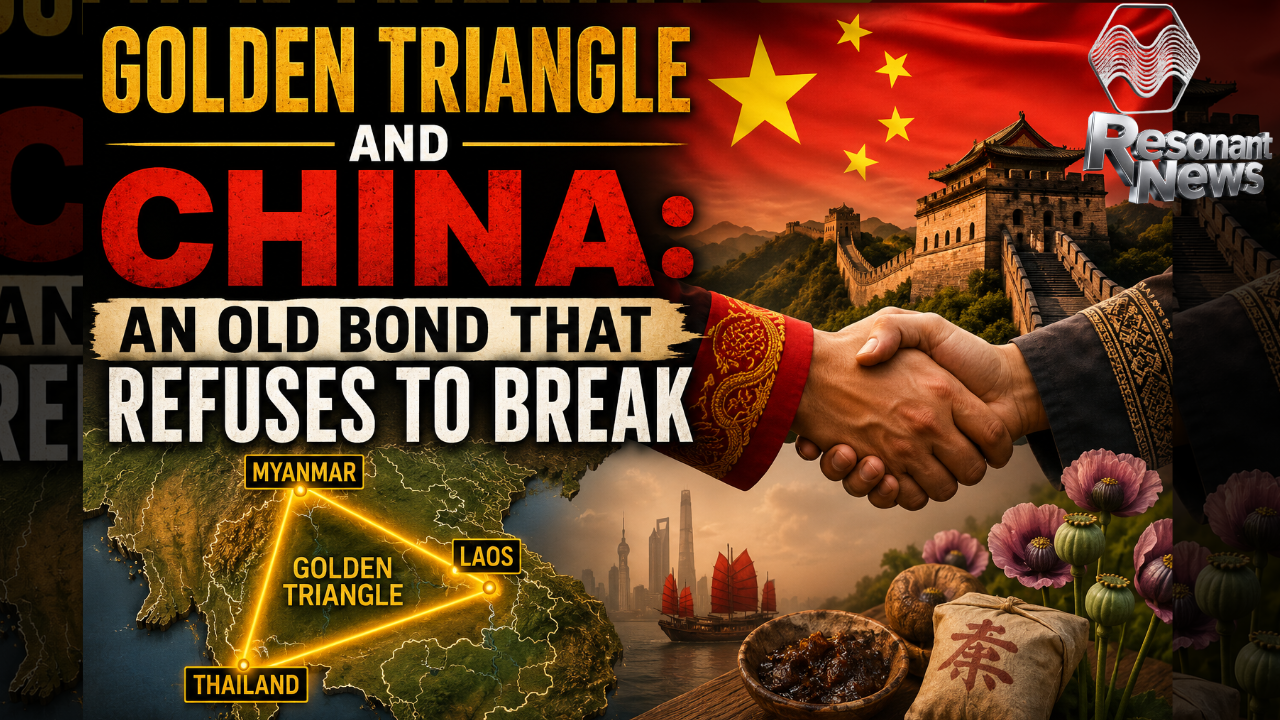

A short history of the Golden Triangle opium trade and its long entanglement with China
Where the mountains of Myanmar meet those of Laos and Thailand lies the Golden Triangle, a borderland that has fed the world’s illicit opium trade for longer than almost anywhere else. Its story cannot be told without China. The two have been bound together for nearly two centuries, first by commerce and conquest, then by revolution and contraband and now by an uneasy struggle over a trade that keeps changing its shape.
The link began with colonial commerce. The British East India Company shipped Indian opium to Chinese ports in growing quantities and when Qing officials tried to suppress the traffic the clash produced the Opium Wars of 1839 to 1842 and 1856 to 1860. China was forced to accept the drug at treaty point. Colonial administrations across Southeast Asia soon legalised and taxed opium as well and poppy farming took root in the hills of Burma and beyond, supplying millions of habitual users across the region.
Revolution transformed the trade. When the Communists won the Chinese civil war in 1949 they stamped out opium at home within a few years, something no earlier government had managed. But roughly twelve to fifteen thousand defeated Nationalist soldiers fled Yunnan into Burma’s Shan States and regrouped there. Kept alive with discreet American support meant for harassing the new People’s Republic, they found a more reliable income in opium. They organised caravans and coerced hill villages into growing poppy and Shan State output climbed from some forty tonnes after the war to several hundred tonnes by the early 1960s. At their height these remnant armies controlled as much as ninety percent of the region’s traffic. A joint offensive by Chinese and Burmese forces in 1960 and 1961 finally pushed most of them into Thailand and Laos, yet the trade they had industrialised survived them.
What followed was a war economy. Through the Cold War the Communist Party of Burma and a succession of ethnic armies financed themselves from poppy fields in the borderlands. The most famous warlord, Khun Sa, commanded perhaps eighty percent of Burma’s opium and more than half the world’s heroin at his peak before surrendering to the junta in 1996. After the Communist Party collapsed in 1989 its militias, above all the United Wa State Army, took over the business and still dominate much of it.

Khun Sa
China felt the consequences as corridor and as victim. From the 1970s into the 1990s heroin moved through Yunnan toward Guangdong and Hong Kong for export. Then the flow turned inward. Drugs returned to China with the open-door reforms of the 1980s and the country’s first recorded HIV outbreak among injecting users came in 1989 in Ruili, a border town in Yunnan. Studies in the early 1990s found infection rates among local injectors that shocked public health officials and by the mid-2000s injection drug use accounted for roughly forty percent of China’s reported HIV cases. The epidemic then travelled along the trafficking routes deep into the interior.
Beijing’s response hardened after October 2011 when thirteen Chinese crew members were murdered on the Mekong River near the Golden Triangle. China pressed its neighbours into an unprecedented arrangement of joint river patrols with Laos, Myanmar and Thailand. The gang leader responsible, Naw Kham, was captured in Laos, tried in Kunming and executed in 2013, a case followed live on Chinese television.
The trade is now changing shape rather than shrinking. Since Myanmar’s 2021 coup the drug economy has expanded amid conflict and economic collapse. The UN Office on Drugs and Crime reported in December 2025 that poppy cultivation had risen seventeen percent in a year to 53,100 hectares, a ten-year peak. With Afghanistan’s ban cutting output there by about ninety-five percent Myanmar is again the world’s main source of illicit opium. Synthetic drugs, above all methamphetamine, have overtaken heroin as the region’s biggest export and reach markets from Australia to India. The Golden Triangle remains the principal source of drugs seized in China even though direct trafficking into China through the tri-border area fell by twenty percent in 2024.
The influence between the Golden Triangle and China has therefore always run in both directions. China was the market that created the trade, the revolution that displaced it, the corridor that carried it and now the strongest power trying to contain it. That long entanglement explains why no solution has ever come from enforcement alone. It also explains why the poppy keeps returning whenever the state around it weakens.
Bibliography
AP News. “Myanmar Opium Production Hits Highest Level in 10 Years.” 3 December 2025. https://apnews.com/article/myanmar-united-nations-opium-survey-drugs-217ba470970142b3599bb62e1292aabc
Bangkok Post. “Outlaws on the Mekong.” 27 January 2012. https://www.bangkokpost.com/thailand/politics/277199/outlaws-on-the-mekong
Beyrer, Chris, Myat Htoo Razak, Khomdon Lisam, Jie Chen, Wei Lui and Xiao-Fang Yu. “Overland Heroin Trafficking Routes and HIV-1 Spread in South and South-East Asia.” AIDS 14, no. 1 (2000): 75-83.
Central Intelligence Agency. “CIF Involvement in Narcotics Trafficking.” Declassified document CIA-RDP86T01017R000808060002-7. CIA Reading Room. https://www.cia.gov/readingroom/docs/CIA-RDP86T01017R000808060002-7.pdf
Chouvy, Pierre-Arnaud. Opium: Uncovering the Politics of the Poppy. Cambridge, MA: Harvard University Press, 2010. Chapter 3, “Opium and Heroin in Asia: The Golden Triangle and the Golden Crescent.” https://www.degruyterbrill.com/document/doi/10.4159/9780674056244-006/html
Chouvy, Pierre-Arnaud and Joel Meissonnier. “The Historical and Geographic Context of the Golden Triangle.” Book chapter, OpenEdition, 2004. https://doi.org/10.4000/12egn
China Daily. “China Readies Armed Patrols of Mekong.” 9 November 2011. https://www.chinadaily.com.cn/china/2011-11/09/content_14060612.htm
ECNS. “Bringing Mekong Murder to Justice.” 19 September 2012. http://www.ecns.cn/2012/09-19/27133.shtml
Li, Jianhua, Toan H. Ha, Cunmin Zhang and Hongjie Liu. “The Chinese Government’s Response to Drug Use and HIV/AIDS: A Review of Policies and Programs.” Harm Reduction Journal 7 (2010). https://pmc.ncbi.nlm.nih.gov/articles/PMC2847555/
Mattis, Peter. “Mekong Murders Spur Beijing to Push New Security Cooperation.” China Brief, Jamestown Foundation, 11 November 2011. https://jamestown.org/mekong-murders-spur-beijing-to-push-new-security-cooperation/
McCoy, Alfred W., with Cathleen B. Read and Leonard P. Adams II. The Politics of Heroin in Southeast Asia. New York: Harper and Row, 1972. Excerpt “Secret War in Burma: The KMT.” http://www.akha.org/content/drugwar/mccoy/29.htm
McCoy, Alfred W. “Searching for Significance among Drug Lords and Death Squads: The Covert Netherworld as Invisible Incubator for Illicit Commerce.” Journal of Illicit Economies and Development (2019). https://doi.org/10.31389/jied.8
Ngeow, Chow Bing. “Dragon in the Golden Triangle: Military Operations of the People’s Liberation Army in Northern Burma, 1960-1961.” Cold War History 23, no. 1 (2023). https://doi.org/10.1080/14682745.2022.2100355
Park, Saeyoung. “China’s Drug War, Part I: The Mekong Incident.” Points History, 16 July 2013. https://www.pointshistory.org/post/china-s-drug-war-part-i-the-mekong-incident
Peng Xu. “Playing with Fire: How Engagement with Illicit Economies Shapes the Survival and Resilience of Ethnic Armed Organisations in the China-Myanmar Borderlands.” China Perspectives (2024). https://doi.org/10.4000/12fwg
Qian, Han-Zhu, Joseph E. Schumacher, Huey T. Chen and Yu-Hua Ruan. “Injection Drug Use and HIV/AIDS in China: Review of Current Situation, Prevention and Policy Implications.” Harm Reduction Journal 3 (2006). https://link.springer.com/article/10.1186/1477-7517-3-4
Reuters (Andrew R. C. Marshall). “Special Report: In Anarchic Mekong, Chinese Murders and Bloody Diplomacy.” 27 January 2012. https://www.reuters.com/article/world/special-report-in-anarchic-mekong-chinese-murders-and-bloody-diplomacy-idUSDEE80Q0D8/
United Nations Office on Drugs and Crime. Myanmar Opium Survey 2024: Cultivation, Production and Implications. Bangkok, December 2024. https://myanmar.un.org/sites/default/files/2024-12/Myanmar_Opium_Survey_2024.pdf
United Nations Office on Drugs and Crime. Myanmar Opium Survey 2025: Cultivation, Production and Implications. Bangkok, December 2025. https://www.unodc.org/roseap/uploads/documents/Publications/2025/Myanmar_Opium_survey_2025_web.pdf
United Nations Office on Drugs and Crime. “Myanmar Remains the World’s Leading Source of Opium and Heroin.” Press release, 12 December 2024. https://www.unodc.org/roseap/en/2024/12/myanmar-opium-survey-report-launch/story.html
United Nations Office on Drugs and Crime. “Myanmar’s Opium Cultivation Reaches Ten-Year Peak.” Press release, 3 December 2025. https://www.unodc.org/unodc/en/press/releases/2025/December/myanmars-opium-cultivation-reaches-ten-year-peak.html
United Nations Office on Drugs and Crime. Synthetic Drugs in East and Southeast Asia: Latest Developments and Challenges. May 2025. https://www.unodc.org/roseap/uploads/documents/Publications/2025/Synthetic_Drugs_in_East_and_Southeast_Asia_2025.pdf
United Nations Office on Drugs and Crime. World Drug Report 2025: Statistical Annex. https://www.unodc.org/unodc/en/data-and-analysis/world-drug-report-2025-annex.html
Vorng, Sophorntavy. “State, Religion and Transnationality in the Golden Triangle.” MMG Working Paper 15-11. Gottingen: Max Planck Institute for the Study of Religious and Ethnic Diversity, 2015. https://hdl.handle.net/11858/00-001M-0000-0029-1FE9-7
Xiao, Yan, Sibylle Kristensen, Jiangping Sun, Lin Lu and Sten H. Vermund. “Expansion of HIV/AIDS in China: Lessons from Yunnan Province.” 2006. https://pmc.ncbi.nlm.nih.gov/articles/PMC2730760/
Zheng, Xin, et al. “Injecting Drug Use and HIV Infection in Southwest China.” AIDS 8, no. 8 (1994). https://pubmed.ncbi.nlm.nih.gov/7986413/

Leave a Reply