
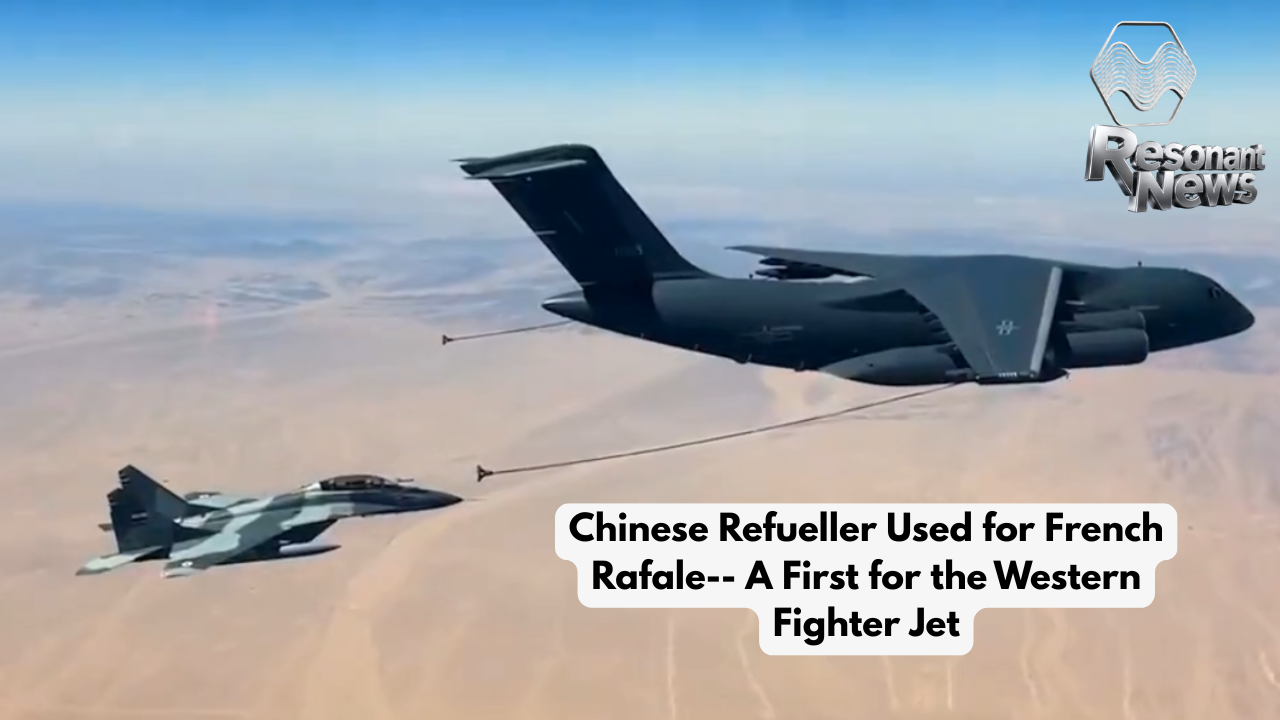

It is standard and highly common for the Dassault Rafale to conduct mid-air refuelings with Western partners, particularly within NATO and allied frameworks. But with a Chinese aerial tanker— its a first!
In an unusual feat of cross-system compatibility, in the first week of September, a Chinese YY-20 tanker was photographed refueling a French-designed Egyptian Rafale. Analysts note this versatility could pave the way for closer multinational missions and boost the tanker’s export appeal
The Rafale relies on a probe-and-drogue refueling system (a extendable probe on the aircraft that plugs into a flexible hose trailed by the tanker).
Because France is a core NATO ally, the French Air and Space Force regularly train with the United States Air Force and Navy. The US and France routinely cross-certify their aircraft; for instance, programs and tests actively align Rafale jets with American tankers and carrier-borne assets (like the F/A-18 Super Hornet ecosystem).
Refueling a French-designed fighter via a Chinese tanker (such as the PLAAF’s YY-20 / Y-20U) is not a routine alliance-based practice, but rather a product of technical compatibility and specific geopolitical or exercise contexts (such as joint military drills involving export clients like Egypt, which flies the Rafale and participates in exercises alongside Chinese hardware).
Mechanically, it is possible because the YY-20 tanker also utilizes a probe-and-drogue system. If an air force uses standard NATO-compatible probe hardware, any probe-and-drogue tanker can technically plug into it. However, doing so operationally requires pre-planned software/hardware alignment, secure comms, and explicit political clearance.
What Does the Recent Y-20 Refueling Representation Mean for India?
Recent observations of Chinese YY-20 tankers operating alongside or supporting foreign deployments (such as regional exercises or transit flights involving nations that operate both Chinese hardware and Western jets like the Rafale) carry several strategic implications for India’s defense establishment:
The YY-20 (Y-20U) represents a massive leap for the People’s Liberation Army Air Force (PLAAF). Turning a strategic transport aircraft into a high-capacity aerial tanker means China is rapidly closing the gap in long-range, sustained air operations. It extends the combat radius of Chinese fighter fleets significantly past traditional boundaries.
When Chinese tankers interface with multi-vendor or non-Western platforms in joint exercises or regional partner nations, it signals Beijing’s growing footprint as an alternative defense logistics provider. It demonstrates that Chinese military logistics are expanding to support diverse or mixed-fleet air arms.
- Two-Front Logistics Pressure: As China builds a robust, expanding tanker fleet, its ability to sustain combat air patrols, long-range bombers, and heavy fighter deployments near the Line of Actual Control (LAC) or across the broader Indo-Pacific increases.
- The IAF’s Tanker Deficit: For India, this reinforces an urgent vulnerability. The IAF has long struggled with a limited pool of mid-air refuelers (relying on a small fleet of Russian-origin IL-78s) and has faced protracted delays in finalizing major tanker acquisition or leasing deals. Watching a rival superpower systematically scale up its force-multiplier assets highlights a critical capability gap India aims to address through fleet expansion and indigenous development.

Leave a Reply