
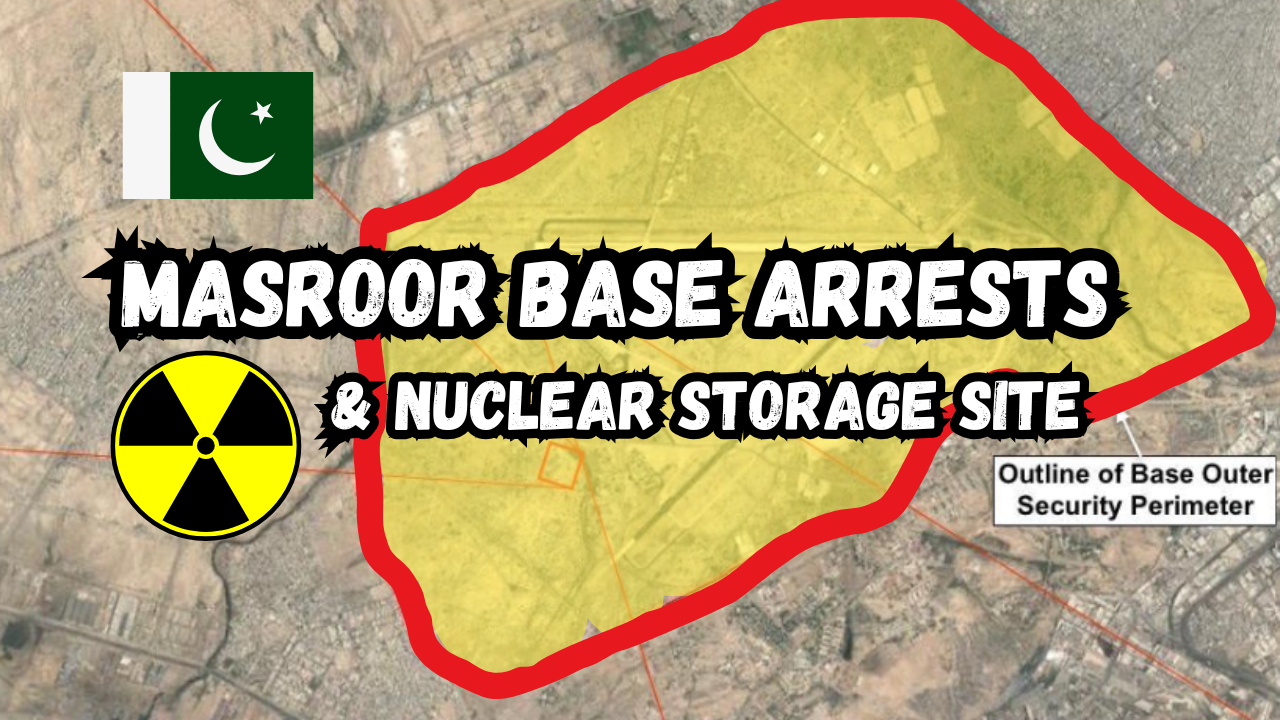

In a significant development, Pakistan’s Intelligence Bureau (IB) has foiled a sophisticated plot to attack Masroor Airbase in Karachi, a critical hub of the Pakistan Air Force (PAF). Authorities arrested nine members of the banned Tehreek-e-Taliban Pakistan (TTP), including five Afghan nationals, from a residence near the base. The 13-month-long scheme, allegedly orchestrated by TTP’s top leadership, aimed to destabilize one of Pakistan’s most vital defense installations. This incident not only underscores the persistent threat of militancy but also raises questions about regional dynamics and Pakistan’s strategic intentions.
Masroor Airbase is no ordinary facility. As Pakistan’s largest airbase—and reportedly Asia’s biggest by area—it plays a pivotal role in the nation’s defense architecture. Located just 5 kilometers from a suspected underground nuclear weapons storage site, the base is shrouded in strategic significance. The facility is fortified with multiple layers of fencing, hardened aircraft shelters, and advanced security measures, reflecting its critical role in Pakistan’s airborne nuclear deterrent.
The base is home to the PAF’s 32 Tactical Attack Wing, which operates a diverse fleet, including JF-17C Thunder Block 2 fighters, Mirage III and V variants, Karakoram Eagle AWACS for surveillance, and AW-139 Seahawk helicopters for search and rescue. This mix equips Masroor to handle missions ranging from air defense and maritime patrols to precision strikes and reconnaissance, making it a linchpin in securing Pakistan’s southern flank and coastal waters.
Historically, Masroor has deep roots, having served as RIAF Base Mauripur during World War II, a transit hub for Allied forces. Named after Air Commodore Masroor Hussain, who heroically sacrificed himself in 1967 to save civilians from a crashing bomber, the base carries a legacy of valor and strategic importance.
This is not the first time TTP has targeted Masroor or similar high-value installations in Karachi. In 2011, the group launched a brazen 16-hour assault on the Pakistan Naval Airbase (PNS Mehran), killing 15 attackers and 18 military personnel while destroying key assets. That attack, considered the navy’s worst loss since 1971, was masterminded by Ilyas Kashmiri, a former Pakistani Special Forces officer turned TTP militant. Kashmiri, who fought Indian forces in Kashmir before joining TTP, exemplified the complex ties between Pakistan’s military past and its militant present.
TTP’s audacity has only grown. Recent videos released by the group show its fighters using drones to strike Pakistani posts and wielding what appear to be advanced anti-tank missiles, raising concerns about their access to sophisticated weaponry. Pakistani media reports suggest the arrested TTP operatives had conducted thorough reconnaissance of Masroor, indicating that, if successful, their attack could have inflicted significant damage on the base’s infrastructure and operations.
The foiled plot comes amid heightened tensions between Pakistan and Afghanistan. Pakistan has accused the Afghan Taliban of sheltering TTP fighters and their families, a charge Kabul denies. Concurrently, Pakistan is deporting thousands of Afghan refugees, a move that has strained bilateral relations further. The arrests of five Afghan nationals in this operation add fuel to Pakistan’s narrative that external actors are abetting TTP’s insurgency.
Past attacks on Karachi’s defense infrastructure—such as the 2014 assaults on the Karachi dockyard and airport—highlight the city’s vulnerability as a target for militants. The involvement of figures like Tahawwur Rana, a former Pakistan Army soldier linked to the 2008 Mumbai attacks and recently extradited to India, underscores the blurred lines between state and non-state actors in the region’s terror landscape.
The timing of this announcement raises intriguing questions. Some analysts speculate that Pakistan may be amplifying the TTP threat to draw international attention, particularly from the United States, to alleged militant sanctuaries in Afghanistan. By framing Masroor—and its nearby nuclear facility—as a target, Pakistan could be positioning itself to push for external action against TTP, much like India’s 2019 Balakot airstrike against terrorist camps in Pakistan’s Khyber Pakhtunkhwa.
Yet, this narrative invites skepticism. If TTP camps are indeed operating across the border, why hasn’t Pakistan’s military, equipped with advanced air and intelligence capabilities, targeted them directly? The PAF’s ability to conduct precise operations, as demonstrated in past exercises, suggests it has the means to strike such targets. This hesitation fuels speculation about Pakistan’s broader strategy—whether it seeks to leverage the TTP threat to secure geopolitical leverage or deflect scrutiny from its own complex history with militancy.
The foiled attack reaffirms Masroor’s status as a high-value asset. Beyond its operational role, the base houses critical training institutions like the College of Aviation Safety Management and supports Pakistan’s maritime security through coastal surveillance. Its proximity to Karachi’s port, a lifeline for trade, amplifies its role in protecting economic interests. The base’s advanced early warning systems and multi-role aircraft ensure it remains a cornerstone of Pakistan’s deterrence posture.
As Pakistan navigates a volatile security landscape, Masroor Airbase stands as both a shield and a symbol—of military strength, historical legacy, and the challenges of combating a threat that, ironically, has roots in the country’s own past. Whether this incident marks a genuine victory against terror or a calculated move in a larger geopolitical game, it underscores the enduring stakes surrounding one of Asia’s most formidable airbases.

Leave a Reply