
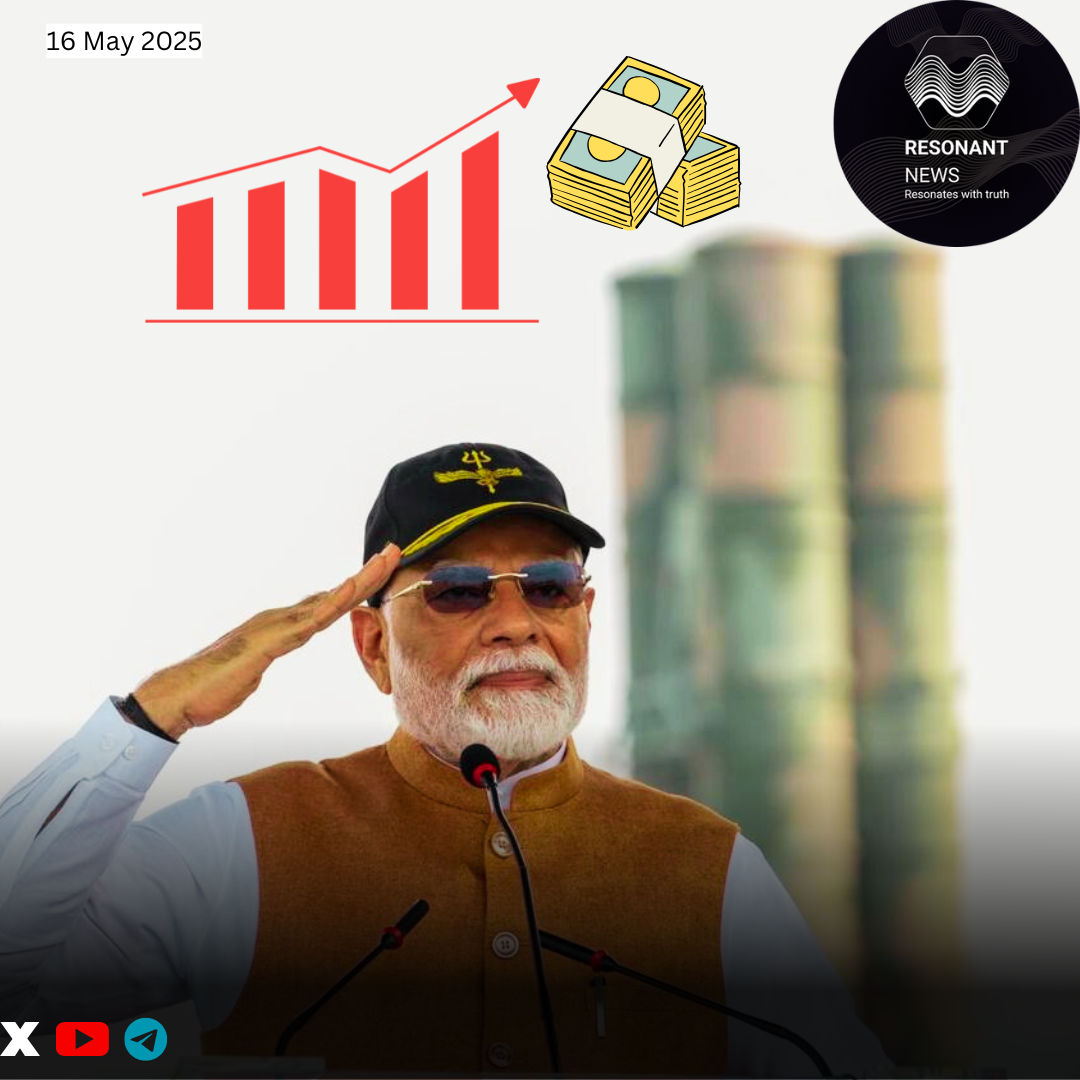

Reports claimed that India’s defence budget is poised for a significant increase of approximately Rs 50,000 crore, driven by the strategic imperatives highlighted by Operation Sindoor. This additional funding, expected to be allocated through a supplementary budget, will push India’s total defence expenditure beyond Rs 7 lakh crore for the 2025/26 fiscal year. The proposal is slated for approval during the upcoming Winter Session of Parliament.
On February 1, 2025, Finance Minister Nirmala Sitharaman announced a defence allocation of Rs 6.81 lakh crore in the 2025/26 Union Budget, marking a 9.2% rise from the Rs 6.22 lakh crore allocated in 2024/25. The proposed boost will further elevate this figure, underscoring the government’s commitment to bolstering military capabilities. Since the Narendra Modi-led government took office in 2014, defence spending has nearly tripled from Rs 2.29 lakh crore in 2014/15. Currently, the defence budget constitutes 13% of India’s total budget, making it the highest among all ministries.
The additional funds are expected to support critical areas such as research and development, procurement of advanced weaponry, ammunition, and essential equipment. This financial commitment reflects India’s focus on enhancing its defence readiness amid regional tensions, particularly with Pakistan, following the April 22, 2025, terror attack in Pahalgam and India’s subsequent military response through Operation Sindoor.
Operation Sindoor and India’s Military Prowess
Operation Sindoor, a targeted military operation against terrorist camps in Pakistan and Pakistan-occupied Kashmir, showcased India’s advanced military capabilities. The operation highlighted the seamless integration of tactical precision and cutting-edge air defence systems, drawing comparisons to Israel’s Iron Dome. A key component of this success was the indigenous Akash missile defence system, which underscored India’s growing self-reliance in defence technology. The operation not only demonstrated India’s military strength but also emphasized the need for sustained investment in defence infrastructure.
Pakistan’s Defence Budget Overview
Pakistan’s defence budget for the fiscal year 2024/25, as announced in June 2024, stands at approximately PKR 2.15 trillion (roughly USD 7.7 billion at current exchange rates). This represents a 14.2% increase from the PKR 1.88 trillion allocated in 2023/24, reflecting Pakistan’s efforts to modernize its military amid economic challenges and regional security concerns. The defence budget accounts for roughly 11-12% of Pakistan’s total federal budget, though this figure is often debated due to additional off-budget military expenditures and pensions.
Key priorities for Pakistan’s defence spending include maintaining a robust conventional force, upgrading air and naval capabilities, and sustaining its nuclear arsenal. The Pakistan Army, which receives the largest share of the budget, focuses on counterterrorism operations and border security, particularly along the Line of Control (LoC) with India and the Durand Line with Afghanistan. Recent procurements include Chinese J-10C fighter jets and upgrades to naval frigates, indicating a focus on enhancing deterrence against India.
However, Pakistan’s defence spending is constrained by its economic situation, with high inflation, a depreciating currency, and reliance on international loans impacting fiscal flexibility. Unlike India’s significantly larger defence budget (approximately USD 84 billion for 2025/26), Pakistan’s military spending is roughly one-tenth of India’s, highlighting the asymmetry in their defence capabilities. This gap fuels Pakistan’s reliance on asymmetric warfare tactics, including support for non-state actors, which has been a point of contention with India, as evidenced by the Pahalgam attack.
The increased defence budget for India comes at a time of heightened tensions with Pakistan, exacerbated by the Pahalgam terror attack and Operation Sindoor. India’s investment in advanced defence systems and indigenous technology aims to strengthen its strategic posture in the region, particularly along the volatile LoC. Meanwhile, Pakistan’s defence budget, though modest in comparison, supports its strategy of maintaining credible deterrence through a mix of conventional and unconventional means.
The disparity in defence spending underscores the broader geopolitical rivalry between the two nations. For India, the budget boost is a step toward consolidating its position as a regional power with global aspirations, while Pakistan’s military spending reflects its focus on countering India’s dominance while navigating internal economic pressures. As both nations prioritize defence modernization, the India-Pakistan border remains a flashpoint, with implications for regional stability.
India’s proposed Rs 50,000 crore defence budget increase, spurred by Operation Sindoor, signals a robust commitment to military modernization and regional security. The operation’s success highlighted India’s advanced defence capabilities, particularly its homegrown systems. In contrast, Pakistan’s defence budget, while growing, is limited by economic constraints, shaping its reliance on asymmetric strategies. As India and Pakistan continue to navigate their complex rivalry, their defence budgets will play a pivotal role in shaping the security landscape of South Asia.

Leave a Reply