

Last week’s report on Operation Sindoor revealed that Jaish-e-Mohammed (JeM) and Hizbul Mujahideen (HM) have been relocating their terror training and lodging facilities to Khyber Pakhtunkhwa (KPK). Recent updates from Operation Sindoor indicate that Jaish-e-Mohammed (JeM) and Hizbul Mujahideen (HM) are moving their terrorist training and accommodation centers to Khyber Pakhtunkhwa (KPK).

It has now been observed that, alongside JeM and HM, Lashkar-e-Taiba (LeT), Pakistan’s largest state-sponsored and UN-designated terrorist group, has also shifted its major operational and training infrastructure to deeper parts of KPK, moving away from Pakistan-occupied Kashmir (PoK) and Punjab, likely to evade potential Indian military actions.
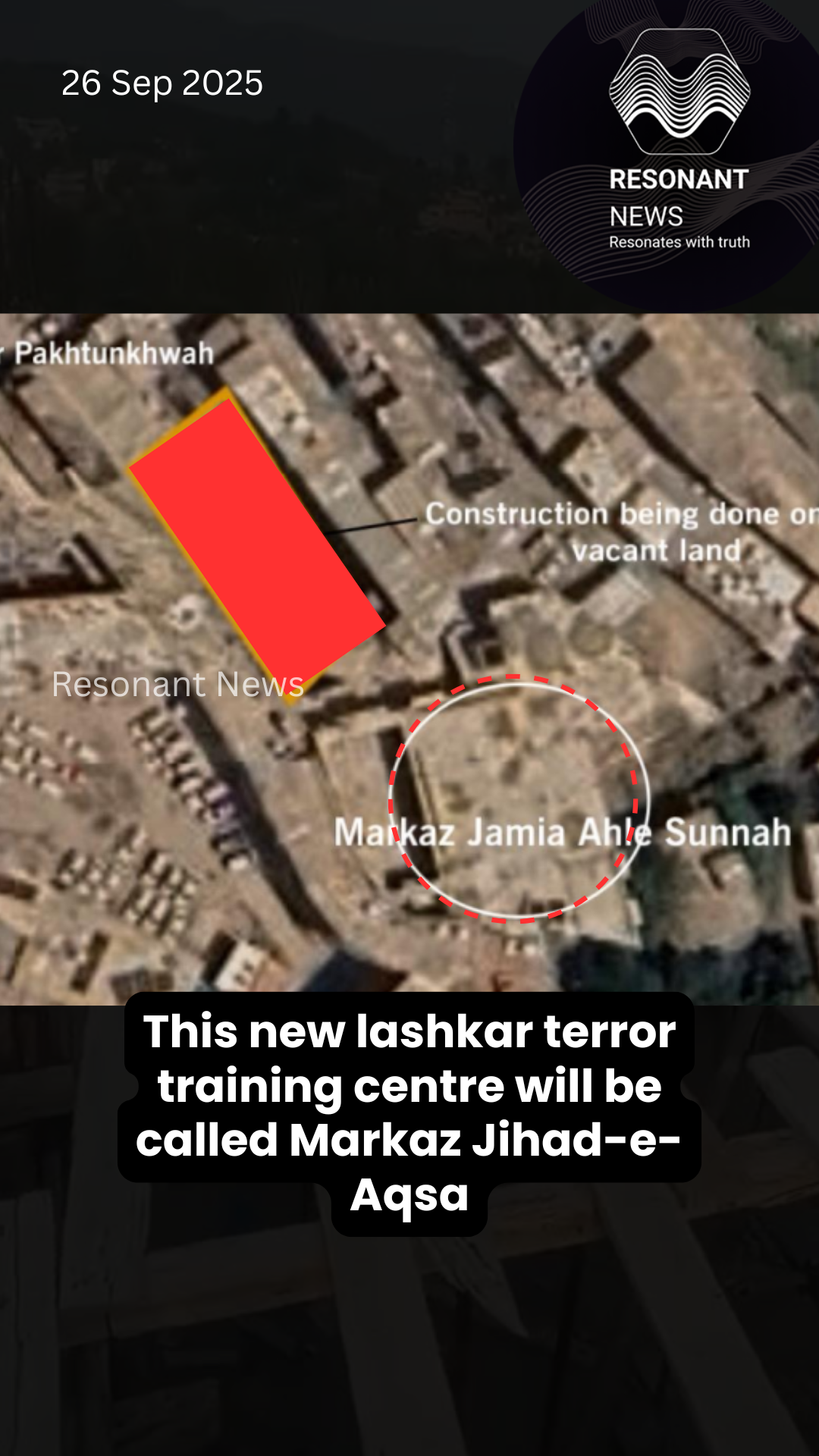
It has been noted that, in addition to JeM and HM, Lashkar-e-Taiba (LeT), a prominent UN-designated terrorist organization backed by Pakistan, has relocated its extensive operational and training facilities further into KPK, distancing itself from PoK and Punjab, probably to avoid future Indian strikes. Evidence, including photos and videos dated September 22, 2025, confirms that LeT is building a new terror training and residential complex, named Markaz Jihad-e-Aqsa, in the Kumban Maidan area of Lower Dir district, approximately 47 kilometers from the Afghan border. Visual evidence, including images and footage from September 22, 2025, verifies that LeT is constructing a new terrorist training and housing facility, called Markaz Jihad-e-Aqsa, in the Kumban Maidan region of Lower Dir district, about 47 kilometers from Afghanistan’s border.
Construction of the facility started in July 2025, two months after Operation Sindoor, and imagery shows that the first-floor structure is complete, with efforts ongoing to install an RCC roof as of September 22, 2025. Work on the complex began in July 2025, two months following Operation Sindoor, and images indicate that the first floor is finished, with construction of an RCC roof in progress as of September 22, 2025. The facility spans roughly 4,643 square feet of previously unused land next to LeT’s recently constructed Jamia Ahle Sunnah mosque, a tactic consistent with LeT’s practice of using religious institutions as a cover to avoid detection. The complex covers approximately 4,643 square feet of vacant land adjacent to LeT’s newly built Jamia Ahle Sunnah mosque, reflecting LeT’s strategy of disguising training facilities as religious sites to evade scrutiny.

The new center is under the command of Nasr Javed, a co-planner of the 2006 Hyderabad blast in India, who previously managed LeT’s Dulai training camp in PoK from 2004 to 2015 and is currently active with LeT’s fundraising arm, Khidmat-e-Khalq (formerly the UN-banned Falah-e-Insaniyat Foundation).
Leadership of the facility has been assigned to Nasr Javed, a key figure in the 2006 Hyderabad bombing in India, who ran LeT’s Dulai camp in PoK from 2004 to 2015 and now oversees operations for LeT’s fundraising wing, Khidmat-e-Khalq (previously the UN-proscribed Falah-e-Insaniyat Foundation).
Muhammad Yasin, also known as Bilal Bhai, has been assigned to provide doctrinal instruction on jihad, while Anas Ullah Khan, trained at LeT’s Garhi Habibullah camp in 2016, is responsible for overseeing weapons training operations. Muhammad Yasin, alias Bilal Bhai, is tasked with delivering ideological training on jihad, while Anas Ullah Khan, who underwent training at LeT’s Garhi Habibullah camp in 2016, manages operational weapons training.
The camp’s location near LeT’s newly built and existing religious seminary, Markaz Jamia Ahle Sunnah, seems intentional, offering a cover for recruitment, logistics, and masking terror activities as religious operations. The placement of the camp close to LeT’s recently constructed and operational religious seminary, Markaz Jamia Ahle Sunnah, appears strategic, providing a disguise for recruitment, logistical support, and concealing terrorist movements under the pretext of religious activities.

The relocation enhances LeT’s training capabilities away from the Jammu & Kashmir border. The shift strengthens LeT’s training operations at a distance from the Jammu & Kashmir border. Once operational, Markaz Jihad-e-Aqsa is expected to conduct two main training programs, Daura-e-Khas and Daura-e-Lashkar, and serve as the new hub for LeT’s Jaan-e-Fidai Fidayeen unit, replacing the Markaz Ahle Hadith facility in Bhimber-Barnala, destroyed by the Indian Army on May 7. When fully functional, Markaz Jihad-e-Aqsa is anticipated to run two primary training courses, Daura-e-Khas and Daura-e-Lashkar, and act as the new base for LeT’s Jaan-e-Fidai Fidayeen unit, taking over from the Markaz Ahle Hadith facility in Bhimber-Barnala, which was demolished by the Indian Army on May 7.
The camp was relocated to Lower Dir following its targeting by the Indian Army during Operation Sindoor to avoid future strikes by Indian forces. Following its destruction by the Indian Army in Operation Sindoor, the camp was moved to Lower Dir to reduce the risk of future Indian military actions. However, Indian Army possess the capability to strike such distant targets if needed to protect national security and interests. Indian Army officials assert they have the ability to target such remote locations if required to safeguard the country’s security and interests. Recent imagery and reports from last week indicate the simultaneous establishment of an HM camp, HM-313, in Bandaai Maidan of Lower Dir and an expansion of JeM’s Markaz e Shaudha in Mansehra, pointing to a wider trend of terror infrastructure growth in the region. Last week’s visuals and updates reveal the concurrent development of an HM camp, HM-313, in Bandaai Maidan, Lower Dir, and an extension of JeM’s Markaz e Shaudha in Mansehra, signaling a broader pattern of terrorist infrastructure expansion in the area.
The relocation and expansion of LeT, JeM, and HM facilities in KPK suggest either coordinated or parallel efforts, likely directed by Pakistan’s ISI Special Operations Directorate, to avoid Indian intelligence surveillance. The movement and growth of LeT, JeM, and HM facilities in KPK indicate either synchronized or simultaneous initiatives, probably guided by Pakistan’s ISI Special Operations Directorate, to escape Indian intelligence monitoring. In addition to Markaz Jihad-e-Aqsa, sources report that LeT plans to expand existing camps at Markaz e Khyber Garhi Habibullah and Batrasi to restore recruitment, training, and residential operations after the destruction of its facilities in PoK and Punjab, including Gulpur Kotli, Shwai Nala, Bhimber-Barnala, and the Muridke headquarters.
Beyond Markaz Jihad-e-Aqsa, reports suggest LeT intends to enlarge its camps at Markaz e Khyber Garhi Habibullah and Batrasi to rebuild its recruitment, training, and housing operations following the destruction of its sites in PoK and Punjab, such as Gulpur Kotli, Shwai Nala, Bhimber-Barnala, and the Muridke headquarters. Lower Dir has historically been a hub for anti-India militant activity, hosting groups like Al Badr, but LeT and Hizbul Mujahideen had no significant militant presence there before Operation Sindoor. Lower Dir has long been a center for anti-India militant operations, hosting groups such as Al Badr, though LeT and Hizbul Mujahideen had little militant activity in the region prior to Operation Sindoor. Historically, Lower Dir has been a strong operational base for Tehreek-e-Taliban Pakistan (TTP), but due to ideological differences—TTP being Deobandi and anti-Pakistan, while LeT follows Ahle Hadith and is pro-Pakistan—TTP operatives have targeted LeT commanders in Lower Dir.
In the past, Lower Dir served as a key operational stronghold for Tehreek-e-Taliban Pakistan (TTP), but sectarian differences—TTP’s Deobandi anti-Pakistan stance versus LeT’s pro-Pakistan Ahle Hadith ideology—have led to TTP targeting LeT leaders in the area. In 2011, after LeT set up a temporary training center in Lower Dir, a TTP suicide bomb attack at the funeral of an LeT commander killed 20 people. In 2011, following LeT’s establishment of a temporary training facility in Lower Dir, a TTP suicide bombing at an LeT commander’s funeral resulted in 20 deaths. To secure LeT’s operations and ensure uninterrupted training, the Pakistani Army launched a cleanup operation in June 2025 to eliminate TTP operatives in Lower Dir, enabling LeT to begin constructing its new terror center within a month. To protect LeT’s activities and ensure continuous training, the Pakistani Army initiated a clearance operation in June 2025 to neutralize TTP operatives in Lower Dir, allowing LeT to start building its new terrorist facility within a month. This operation reportedly killed over two dozen TTP operatives. The operation is said to have resulted in the deaths of more than 24 TTP members. In Lower Dir, the new LeT and HM camps under construction are just 4 kilometers apart, suggesting potential operational coordination or strategic co-location. The LeT and HM camps being built in Lower Dir are only 4 kilometers apart, indicating possible operational collaboration or intentional proximity. Since June 2025, the Pakistani Army and Air Force have reportedly killed over 40 civilians in airstrikes, officially claiming these actions aim to make KPK terror-free. Since June 2025, the Pakistani Army and Air Force are said to have killed more than 40 civilians in airstrikes, claiming these operations are intended to eliminate terrorism in KPK.
In reality, these operations seem focused on eliminating militants hostile to the Pakistani state while facilitating the establishment of anti-India terror groups in the same region, reflecting Pakistan’s strategy of supporting “good terrorism” while combating “bad terrorism.” In practice, these actions appear aimed at neutralizing anti-Pakistan militants while enabling the setup of anti-India terrorist groups in the region, consistent with Pakistan’s policy of endorsing “good terrorism” while suppressing “bad terrorism.” This approach was publicly acknowledged by Pakistan’s Chief Minister, Ali Ameen Gandapur, in a press conference in August 2025. This strategy was openly admitted by Pakistan’s Chief Minister, Ali Ameen Gandapur, during a press conference in August 2025. While Pakistan seeks international funding for counterterrorism, a significant portion of these resources is reportedly diverted to either killing civilians or eliminating anti-state militants, creating a safer environment for state-supported terror groups. Although Pakistan requests global funds for counterterrorism efforts, much of these resources are allegedly used to target civilians or eliminate anti-Pakistan militants, fostering a secure environment for state-backed terrorist organizations. LeT’s new training center, expected to be completed by December 2025, poses a medium-to-high long-term threat. LeT’s new training facility, projected to be finished by December 2025, presents a moderate-to-significant long-term risk. Though still under construction, it is already emerging as a hub for recruitment, radicalization, and large-scale terrorist training. Despite being under construction, it is already becoming a center for recruitment, radicalization, and extensive terrorist training.
Notably, while the adjacent Markaz Jamia Ahle Sunnah is only about 80% complete, LeT has prioritized all its resources, energy, and funds toward building the Jihad-e-Aqsa training center. Significantly, although the nearby Markaz Jamia Ahle Sunnah is roughly 80% complete, LeT has redirected all its efforts, resources, and funding to constructing the Jihad-e-Aqsa training facility. This shift underscores the urgency and priority LeT places on establishing the new facility. This focus highlights the critical importance and urgency LeT assigns to setting up the new center.
Since September 2025 Resonant News has uncovered 4 such new structures.
- Rise in Dual Use (trt/ civilian) Structures Being Built by Pakistan backed LeT in Kotli along LoC
- Renovated Lashkar-e-Taiba Terror Launchpad Uncovered Near Line of Control in Rawalakot
- New Lashkar-e-Tayyiba Proxy Centre in Mirpur; Saifullah Kasuri’s trip To PoJK

Leave a Reply