
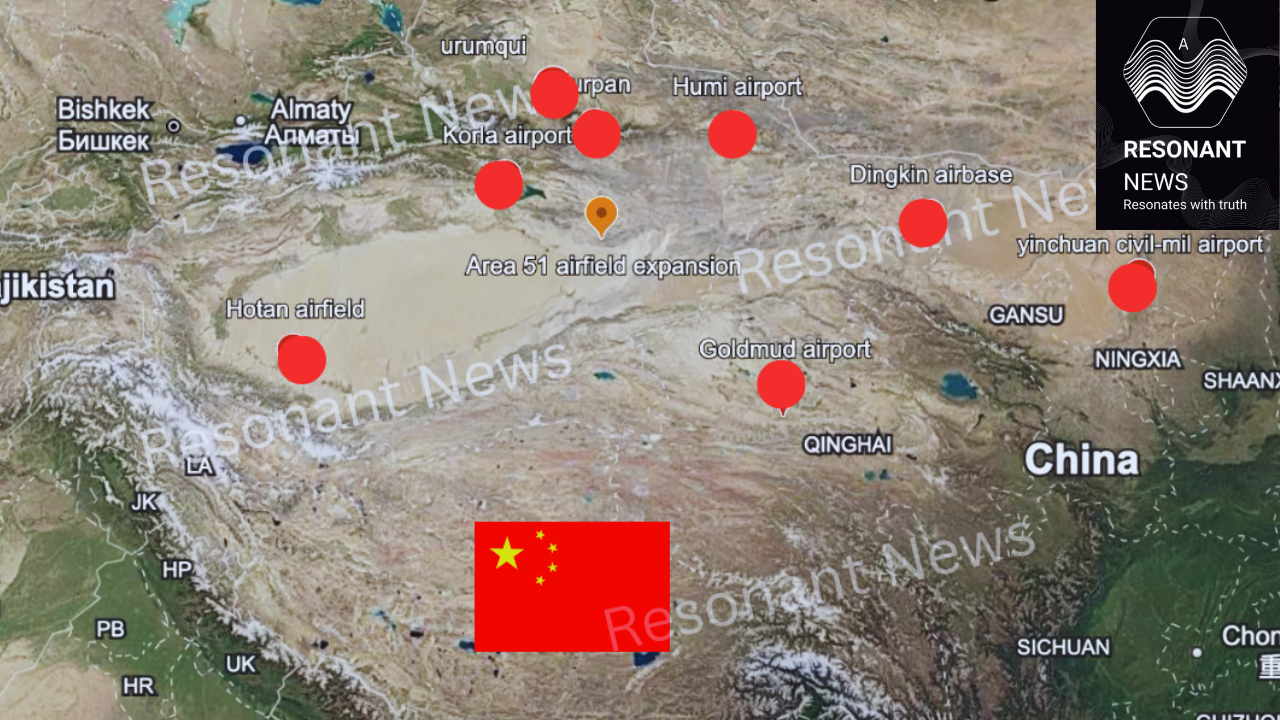

In an interesting development in global military dynamics, the People’s Liberation Army Air Force (PLAAF) has undertaken its most extensive air combat exercise to date, signaling a move from symbolic displays to sophisticated, integrated operations. This analysis draws from a briefing by J. Michael Dahm, a senior fellow at the Mitchell Institute for Aerospace Studies, presented at the Air & Space Forces Association Warfare Symposium on February 25, 2026.
The exercise, dubbed Red Sword and conducted in late 2025, involved over 200 aircraft across a vast remote area in Western China. Unlike the more publicized drills near the Taiwan Strait, this operation was kept low-profile, emphasizing realistic training akin to the U.S. Air Force’s Red Flag exercises. Below are the key details point by point for a clearer understanding of its scope, tactics, and implications.
- Scale and Location: The Red Sword exercise spanned a 1,200-nautical-mile operational area, utilizing eight remote air bases in an almost uninhabited region of Western China. This vast expanse allowed for comprehensive rehearsals of long-range scenarios, far from public or international scrutiny. Commercial satellite imagery revealed at least 194 aircraft visible in the open, with estimates suggesting the total could exceed 200 or even reach 250, including those potentially sheltered in hangars.
- Duration and Structure: Lasting five weeks, the exercise was significantly longer than comparable U.S. drills, such as the recent Red Flag combined with Bamboo Eagle, which ran for three weeks and involved only 150 aircraft over about 1,000 miles. By late November 2025, many participating aircraft converged at Dingxin Air Base in the Gobi Desert—a facility often likened to Nellis Air Force Base in the U.S.—where over 100 aircraft operated for more than two weeks.
- Aircraft Composition and Integration: The operation featured a diverse mix of aircraft types, indicating advanced multi-generation tactics. Key platforms included Chengdu J-20 stealth fighters, Shenyang J-16 fighters, Xi’an H-6 bombers, Y-20 transports, and Shaanxi KJ-500 airborne early warning and control (AEW&C) aircraft. Bases typically dedicated to one type, like J-16s, hosted “uncharacteristic flotillas” of others, suggesting roles as simulated adversary groups. This setup facilitated dissimilar air combat training, where fighters engaged different types, and potentially fighter integration—combining fourth- and fifth-generation capabilities for enhanced tactics, techniques, and procedures.
- Stealth and Operational Secrecy: Stealth aircraft like the J-20 were often hangared to protect their radar-absorbent materials from environmental degradation, underscoring the PLAAF’s focus on maintaining technological edges. The exercise’s remote location and lack of public announcements contrast with “flashy” one- or two-day drills in the Taiwan Strait, which Dahm notes are designed to draw attention while diverting from these more substantive preparations.
- Insights from Previous Exercises: While details on prior Red Sword iterations in 2013, 2017, and 2020 are sparse, the 2025 event provides fresh revelations about the PLAAF’s evolution into a modern force. No apparent geopolitical tensions, such as on the China-India border, justified the buildup, confirming it as a dedicated training event rather than a response to immediate threats.
- Industrial Expansion and Future Projections: Satellite analysis highlighted rapid growth in China’s defense infrastructure. The state-run Aviation Industry Corporation of China (AVIC) has added 8 million square feet of manufacturing space since 2021, exceeding the entire Lockheed Martin F-35 complex in Fort Worth, Texas. Recent additions include 60,000 square feet of hangar space and 300,000 square feet of facilities at a remote PLAAF test site for classified programs. Prototypes like sixth-generation J-36 and J-50 fighters were spotted in the open, possibly as a deliberate show of strength. This expansion supports the PLAAF’s modernization, phasing out older aircraft for next-generation models.
- Comparative Force Projections: In a “worst-case scenario,” Dahm projects that by 2028, the combined PLAAF and PLA Navy fighter force could match the U.S. total (including Air Force, Navy, and Marine Corps). By 2029, China is poised to field the world’s largest fighter force, continuing to expand while investing more in airpower than the rest of the world combined.
This Red Sword exercise shows China’s strategic pivot toward high-end warfare capabilities, potentially reshaping regional and global security balances. The detailed assessment, grounded in open-source intelligence like satellite imagery, highlights the PLAAF’s growing sophistication. J. Michael Dahm’s of Mitchell Institute says
” At the time of the ex there was nothing happening along India-China border to justify such a large buildup’.

Leave a Reply