
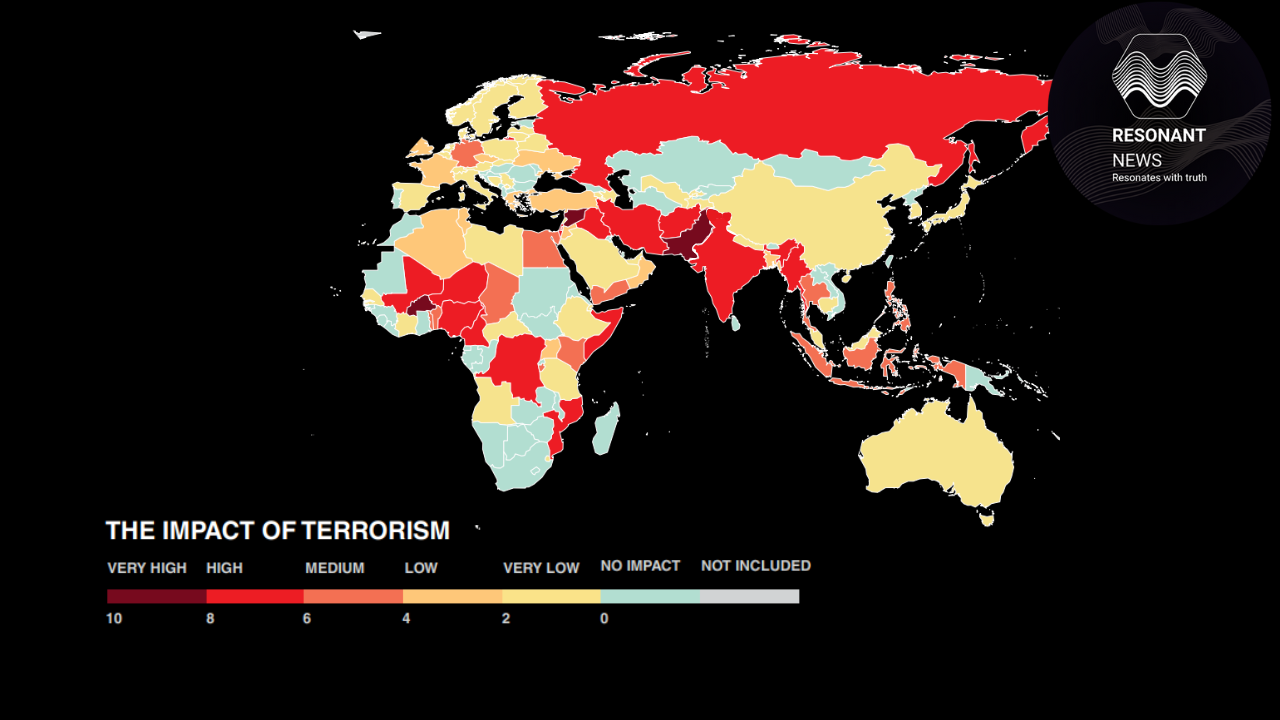


Global terrorism Index 2025 claims India is the 14th most impacted country in the world, and Pakistan is at the second position. The countries with the most attacks not attributed to a group were Pakistan, Mali and India. GTI calls TTP the 3rd deadliest terror group in the world.
Summary of Global terrorism index
• In 2024, terrorism-related deaths fell to 7,555, a 13% decrease from the previous year.
• The decline was entirely due to the sharp rise in deaths in the previous year from the Hamas October 7th attack; otherwise, the numbers would have remained stable.
• The number of terrorist attacks dropped by 3%, totaling 3,492.
• This decrease was primarily driven by an 85% reduction in terrorist activity in Myanmar.
• Excluding Myanmar, global terrorist attacks would have increased by 8%.


TTP, Baloch and Pakistan:
Tehrik-e-Taliban Pakistan (TTP) was the third deadliest terrorist group in 2024, responsible for 558 deaths across 482 attacks—the second-highest number of attacks by any single group that year. After a period of reduced activity between 2017 and 2021, the group has experienced a resurgence, with attacks more than doubling in the past year and deaths increasing by 90%. In 2024, the number of attacks attributed to the TTP reached its highest level on record, while deaths caused by the group were at their highest since 2011.
The TTP’s activities are largely concentrated along Pakistan’s northern border with Afghanistan, with 96% of its 2024 attacks occurring in Khyber Pakhtunkhwa province. This is likely due to the province’s proximity to Afghanistan’s capital. Attacks in Khyber Pakhtunkhwa more than doubled, rising from 182 attacks and 265 deaths in 2023 to 462 attacks and 545 deaths in 2024. The deadliest TTP attack of the year took place in this province, where TTP militants killed 16 Pakistani soldiers at an army outpost, claiming it was in retaliation for the killing of senior TTP commanders. Terrorist activity remained relatively low in other regions, with only 13 out of the 558 terrorism-related deaths occurring outside Khyber Pakhtunkhwa.
Tactics Used by TTP:
The TTP primarily targeted state forces in line with its anti-government objectives. Police personnel were the most frequent targets, accounting for 51% of attacks, followed by military personnel at 16%. Civilians were also significantly affected, making up 16% of attacks and 19% of terrorism-related deaths.
Armed assaults remained the TTP’s most commonly used tactic in 2024, responsible for nearly two-thirds of attacks and 72% of deaths. Bombings were the second most frequent method, with the number of bombings nearly tripling compared to the previous year.
Rising Impact of Terrorism in Pakistan:
The impact of terrorism in Pakistan intensified significantly, with deaths from terrorist attacks rising by 45% to 1,081 in 2024. This marked the fifth consecutive year of increasing terrorism deaths and represented the largest year-on-year increase in the past decade. The number of terror attacks also more than doubled, surging from 517 in 2023 to 1,099 in 2024—the first time attacks have exceeded 1,000 since the inception of the Index.
Terrorism has escalated in Pakistan since the Taliban’s return to power in Afghanistan, with militant groups operating from Afghan territory intensifying attacks along the Pakistan-Afghanistan border. The provinces of Balochistan and Khyber Pakhtunkhwa remain the hardest-hit regions, accounting for over 96% of terrorist attacks and deaths in Pakistan in 2024.
For the second consecutive year, TTP remained the deadliest terrorist group in Pakistan, responsible for 52% of the country’s terrorism-related deaths. In 2024, the group carried out 482 attacks, resulting in 558 fatalities—a 91% increase from 293 deaths in the previous year. This marks the highest level of activity for the TTP since 2009.
Meanwhile, the Balochistan Liberation Army (BLA) was behind Pakistan’s deadliest terrorist attack of 2024, when a suicide bomber killed at least 25 civilians and soldiers at Quetta railway station in Balochistan. Baloch militant groups, including the BLA and the Balochistan Liberation Front (BLF), have exploited Pakistan’s instability, increasing their attacks from 116 in 2023 to 504 in 2024. Deaths from these attacks surged more than fourfold, rising from 88 in the previous year to 388 in 2024.
Since the Taliban’s takeover of Afghanistan in 2021, the TTP has taken advantage of increased operational freedom and safe havens across the border, allowing it to plan and execute attacks with greater impunity. The group has continued targeting security forces and infrastructure to weaken state authority and disrupt military operations. In response, the Pakistani government has introduced counterterrorism measures, including Operation Azm-e-Istehkam.
At the same time, the rise in Baloch militant activity has significantly contributed to Pakistan’s worsening security situation. The BLA has strongly opposed the government’s policies on resource extraction, arguing that Balochistan’s natural resources are being exploited without fair development or compensation for the local population. The group has also targeted foreign investments, particularly Chinese projects under the China-Pakistan Economic Corridor (CPEC), which it claims marginalize the Baloch people.
To further its objectives, the BLA has escalated attacks on Chinese nationals and infrastructure, aiming to disrupt these projects and draw international attention to its cause.
The dual threat posed by the TTP and Baloch militant groups highlights the complex security challenges facing Pakistan in 2024. Addressing these threats will require a combination of military action, political engagement, and socio-economic initiatives to ensure long-term stability.
ISKP:
Islamic State Khorasan Province (ISK), originally established to counter the Taliban, has grown into one of the most active jihadist groups globally. Since its formation in 2015, ISK has steadily expanded its operations beyond Afghanistan, extending into Pakistan, Iran, Russia, and Central Asia.
In 2024, ISK was responsible for two of the deadliest terrorist attacks, one in Iran and another in Russia. The group has intensified its recruitment efforts, producing multilingual propaganda aimed at audiences in South and Central Asia.
ISK’s linguistic reach is particularly extensive, with content available in Pashto, Dari, Arabic, Urdu, Farsi, Uzbek, Tajik, English, and, more recently, Russian and Turkish. Additionally, it provides remote training on tactics, target selection, and weapons procurement through official ISK members.
Technology, particularly artificial intelligence, is transforming how terrorist organizations communicate and recruit. ISK, for example, is producing a range of high-quality content, from online magazines to AI-enhanced videos, including news-style programs. This allows for the rapid creation of localized propaganda.
Platforms like Telegram and Rocket offer private, invitation-only spaces for communication, while the dark web serves as a hub for illicit activities and ideological exchanges. These factors further amplify the risks of exposure and radicalization.
Lone- Wolf attacks in Europe; lack of intelligence
Lone-actor terrorism is on the rise in the West, with attacks increasing from 32 to 52 in 2024. These incidents are largely carried out by teenagers who have no formal ties to terrorist organizations. Instead, they become radicalized online, forming personal ideologies influenced by content from fringe forums, gaming platforms, encrypted messaging apps, and the dark web. The absence of organizational affiliations makes it difficult for intelligence agencies to track these threats. Additionally, social media algorithms amplify biases, further pushing disaffected youth toward extremist content. In Europe, one in five individuals arrested for terrorism is legally classified as a child.
Africa & SYria ; Russia & China’s influence
Terrorism in the Sahel has escalated dramatically, with deaths increasing nearly tenfold since 2019. In 2024, the region accounted for 51% of all terrorism-related fatalities, while overall conflict-related deaths surpassed 25,000 for the first time since the Index began. Of these, 3,885 were directly linked to terrorism. The number of terrorism-related deaths in the Sahel is now ten times higher than in 2019.
Geopolitical shifts continue to reshape security dynamics in the Sahel. The Alliance of Sahelian States—comprising Mali, Burkina Faso, and Niger—has distanced itself from the West, instead deepening ties with Russia and China. This realignment, along with the bloc’s withdrawal from ECOWAS, has created opportunities for groups like JNIM to expand their operations into coastal West Africa.
Since 2020, traditional foreign influence in Syria has waned, with Russia, China, and Iran reducing their involvement while Türkiye asserts itself as a dominant regional power. The Kurdish-led Syrian Democratic Forces (SDF), once a key US ally against IS, now face growing challenges. Türkiye’s opposition to a stronger SDF, along with the possibility of reduced US support, has created conditions that IS could exploit to regain strength.

Leave a Reply