
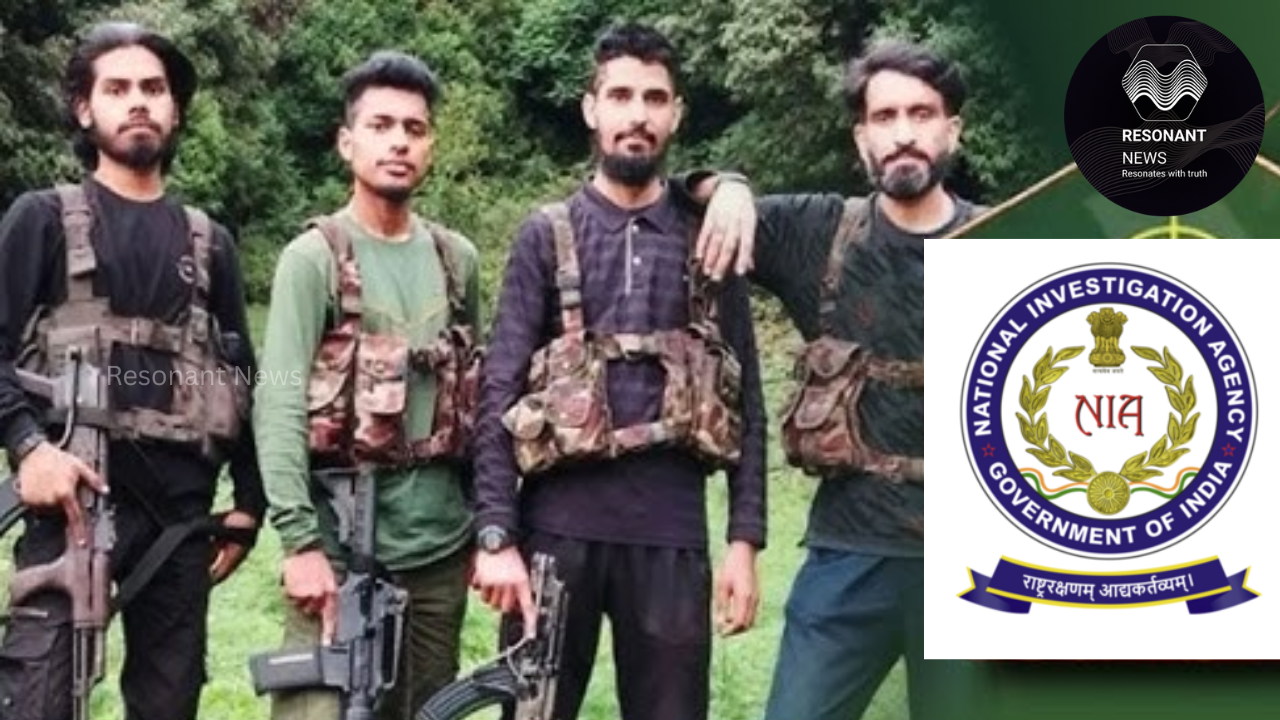

In a resounding affirmation of India’s commitment to the rule of law, the National Investigation Agency (NIA) has filed a comprehensive 1,597-page charge sheet in the special court in Jammu concerning the horrific Pahalgam massacre of April 2025. This document is far more than a routine legal filing; it stands as a meticulously constructed edifice of evidence, exposing the intricate web of cross-border terrorism orchestrated from Pakistan. Over eight months of rigorous investigation, the NIA has pieced together forensic, digital, and logistical proofs that link the attack directly to Pakistan-based militant groups, challenging decades of plausible deniability and underscoring the stark contrast between democratic accountability and state-sponsored impunity.
Tragic Events in Baisaran Valley
The attack unfolded on April 22, 2025, in the serene Baisaran Valley, often dubbed “mini Switzerland,” located about 7 km from Pahalgam in Jammu and Kashmir’s Anantnag district. Between 1:00 and 2:45 p.m., 2-7 armed militants, dressed in military-style uniforms and equipped with M4 carbines, AK-47 rifles, and modern communication devices, stormed the 200m x 800m meadow. The site, accessible only on foot or horseback and lacking armed security, was teeming with tourists enjoying the scenic beauty.
The assailants herded visitors toward the entry gate, separating them by religion. They forced individuals to recite the Islamic Kalima (profession of faith) to identify non-Muslims, checked for circumcision, and demanded identification. Victims who identified as Hindus or failed the tests were executed point-blank, while some Hindu women were spared to “narrate the horrors” to Prime Minister Narendra Modi. The militants captured selfies with the bodies and fired celebratory shots. A local Muslim pony operator, Syed Adil Hussain Shah, heroically attempted to disarm an attacker but was killed in the process.
The toll was devastating: 26 fatalities, including 25 tourists (24 Indians from states like Maharashtra, Gujarat, Karnataka, and others, plus one Nepali) and the local pony operator. Among the dead were a Navy lieutenant (Vinay Narwal), an Air Force officer, an Intelligence Bureau official, newlyweds, and a Christian from Madhya Pradesh (Sushil Nathaniel). Twenty others were injured. Survivors hid behind mobile toilets, in pits, or escaped through fence gaps, with some locals and an off-duty army officer aiding evacuations.
NIA’s Forensic Fortress: Building the Case
The NIA assumed control of the investigation on April 27, 2025, under the Bharatiya Nyaya Sanhita and Unlawful Activities (Prevention) Act (UAPA). Leveraging the elevated evidentiary standards of the Bharatiya Nagarik Suraksha Sanhita and Bharatiya Sakshya Adhiniyam, the agency interrogated over 2,800 individuals, detained more than 150, and demolished homes of suspected militants’ families. The charge sheet, filed on December 15, 2025, accuses Lashkar-e-Taiba (LeT) and its proxy, The Resistance Front (TRF)—both UN-designated terrorist entities—of masterminding the “religion-based targeted killings.”
Key evidence includes:
- Ballistics Analysis: Cartridges from the crime scene matched weapons recovered during Operation Mahadev in July 2025.
- Digital Trails: Communication and financial threads traced to handlers like Sajid Saifullah Jatt in Lahore safe houses, with satellite phone pings (IMEI 86761204-XXXXXX) and voice samples linking to Pakistan’s Inter-Services Intelligence (ISI).
- Physical Proofs: Laminated Pakistani voter IDs from Lahore (NA-125) and Gujranwala (NA-79), micro-SD cards with NADRA biometric records tracing family trees, and even chocolates from consignments shipped to Muzaffarabad in Pakistan-occupied Kashmir (PoK).
- Funding and Logistics: Bank transactions showing ₹9 lakh routed through intermediaries like Yasir Hayat, with 463 calls from anti-India groups in Pakistan, Malaysia, and the Gulf.
The charge sheet names seven accused, including three slain Pakistani nationals charged posthumously: Faisal Jatt alias Suleman (Hashim Musa), Umar Lone alias Sajid Jatt alias Abu Qatal alias Yakub, and Hamza Afghani alias Tahir Habib alias Jibran. Local facilitators arrested include Parvaiz and Bashir Ahmad Jothar (harbored militants), Shafat Maqbool Wani (funding), Ab Majid Gojri, Ab Hamid Dar (weapons), and Mohammad Yousuf Kataria (logistics). This surgical focus on a handful of individuals in a region of over 1.2 million in Anantnag and 7 million in the Kashmir Valley highlights precision over blanket repression.
Exposing Pakistan’s Role: From Denial to Documentation
The probe irrefutably ties the attack to Pakistan’s long-standing proxy war against India, dating back to 1947. Historical parallels abound: the 1947 invasion disguised as a tribal uprising (admitted in Major General Akbar Khan’s memoirs Raiders in Kashmir), the failed 1965 Operation Gibraltar, and the 1999 Kargil intrusion where Pakistan disowned its own soldiers. The Pahalgam massacre fits this pattern, with attackers infiltrating from PoK, trained by LeT/TRF, and directed by ISI-linked commanders.
Pakistan’s denial was swift, offering a “neutral investigation” backed by allies like China, Turkey, and Malaysia—an offer India rejected outright. The charge sheet dismantles such claims by mapping the conspiracy from Pakistani cantonments to the Kashmir meadows. It also notes TRF’s initial claim of responsibility on Telegram (later denied), framing the attack as opposition to post-Article 370 “settler” policies.
Military Response: Operations Mahadev and Sindoor
In the aftermath, India launched defensive operations. Operation Mahadev on July 28, 2025, in Dachigam National Park’s Harwan forest, neutralized three attackers in a swift encounter involving CRPF, J&K Police, and Army Para SF. Recovered items—AK-103 rifles, GoPro cameras, solar chargers, and Pakistani-origin goods—bolstered the evidence.
Tensions escalated into a brief May 2025 standoff, with India conducting airstrikes under Operation Sindoor on terror camps in PoK, suspending the Indus Waters Treaty, expelling diplomats, and closing borders. Pakistan responded with drone and missile strikes, leading to civilian casualties before a ceasefire on May 10.
Aftermath and Broader Implications
The massacre triggered global outrage, with condemnations from over 100 countries, the UN, G7, Quad, BRICS, SCO, and others. The U.S. House criticized media for downplaying it as “militant” actions, while the UN Commission on International Religious Freedom highlighted targeting of Hindus and non-Muslims. Domestically, it sparked protests, vigils, and a surge in Islamophobia, including evictions of Kashmiris and hate crimes, though Muslim groups and Sikh organizations provided aid.
In Jammu and Kashmir, tourism plummeted by 50-52% in the first half of 2025 compared to 2024’s record 23.6 million visitors. Sites closed temporarily, but the region rebounded symbolically through democratic milestones. The 2024 assembly elections saw a 64% turnout overall, with Pahalgam at 71%, including former separatists from Jamaat-e-Islami participating—a rejection of violence in favor of development. Cinemas reopened after decades, markets buzzed, and schools filled, signaling a shift from conflict to prosperity.
The abrogation of Article 370 in 2019, upheld by India’s Supreme Court in 2023 as a temporary provision, extended constitutional rights to marginalized groups like Valmikis and refugees. Critics abroad decry “demographic changes,” yet the charge sheet contrasts this with Pakistan’s systematic settlement in PoK and Gilgit-Baltistan, diluting local Shia majorities—a form of colonial engineering.
A Tale of Two Systems: Democracy vs. Garrison State
This case illuminates fundamental differences in governance. India’s judiciary, even for high-profile matters, operates transparently: The abrogation was debated and upheld in open courts. In contrast, Pakistan’s 27th Amendment in 2025 entrenched military supremacy, shielding chiefs from accountability and treating the constitution as malleable. A nation that abandons its soldiers in Kargil or disappears Baloch activists lacks credibility in offering forensic aid.
The Pahalgam charge sheet is a declaration of India’s resilience. It replaces strategic restraint with legal and military assertion, ensuring justice through institutions rather than whims. As forensic tools strip away facades of “indigenous resistance,” it reaffirms that truth, backed by irrefutable data, will prevail over propaganda. In an era where digital footprints betray conspiracies, India’s response to terror is a model of sovereign strength—slow but inexorable, like a glacier carving its path.

Leave a Reply