
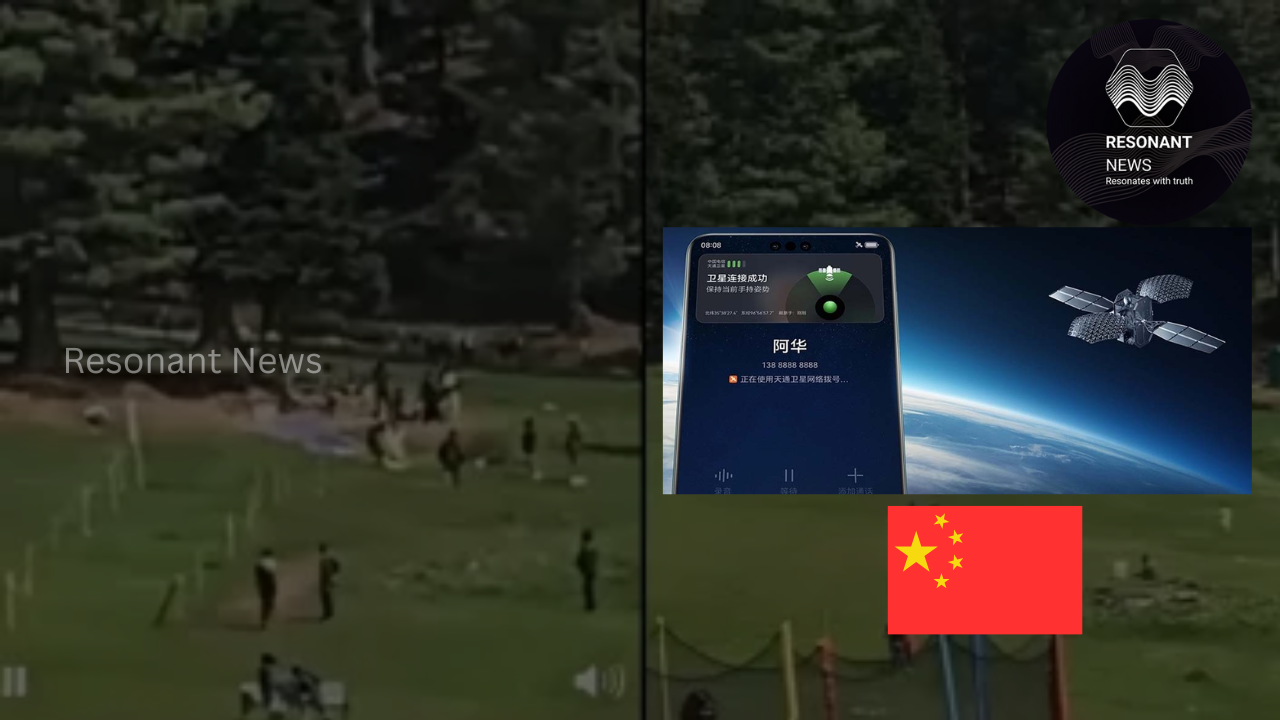

Indian security agencies are investigating the use of a Huawei satellite phone detected near Pahalgam during the April 22, 2025, terror attack, as reported by The Economic Times. Huawei, a Chinese company banned in India, is suspected of having its satellite phones smuggled into the country, possibly from Pakistan or another nation, according to anonymous officials. Indian Agencies are collaborating with Western technical intelligence to trace the device.
The investigation highlights the role of Chinese communication tools, including Huawei satellite phones and encrypted apps, in enabling foreign terrorists to communicate with handlers across borders while evading detection. Over the past year, militants killed in Jammu and Kashmir were found using devices linked to China’s BeiDou Navigation Satellite System (BDS), a high-precision network operated by the China National Space Administration. These BeiDou-enabled devices, such as navigation units and satellite communication tools, allow militants to infiltrate, coordinate, and operate in remote areas without relying on Indian telecom networks. Unlike GPS, BeiDou offers superior accuracy in Asia and resilience against jamming, functioning independently of local infrastructure and supporting two-way satellite messaging for untraceable communication.
Last year Indian forces had recovered ULTRA set from the terrorists. “Ultra-Set” refers to advanced, highly encrypted Chinese telecommunications equipment increasingly utilized by terrorist groups in Jammu and Kashmir. These specialized handsets, reportedly customized exclusively by Chinese firms for the Pakistan military, have drawn significant attention from security agencies.
The “Ultra-Set” devices integrate standard mobile phone functions with specialized radio technology, using radio waves to transmit and receive messages. Unlike conventional mobile networks (GSM or CDMA), these handsets employ a distinct communication system. Each “Ultra-Set” is connected to a control station located across the border in Pakistan, and officials note that these devices cannot communicate directly with one another. Messages are compressed into bytes, transmitted via Chinese satellites from the handset to a master server in Pakistan, and then forwarded to their intended recipients.So terrorists are not new to the Chinese sets.
During the Pahalgam attack a Huawei smartphone, possibly from the Mate 60 Pro or P60 series, was detected emitting signals near site of attack, during the attack, and is under forensic analysis. Unlike older Thuraya satellite phones, which were bulky and easily identifiable, Huawei’s devices integrate Tiantong-1 satellite connectivity into standard-looking handsets, requiring no external antenna or SIM card and operating covertly during cellular blackouts. This makes them ideal for militants to send texts, calls, or location data undetected. Cracking these systems is complex, requiring days of analysis and foreign agency support.
Other Chinese brands like OPPO, Xiaomi, Vivo, and Honor are developing similar satellite-enabled phones, raising concerns about unregulated satellite messaging. This emerging reliance on Chinese satellite technology, particularly BeiDou and Tiantong-1, poses a significant challenge to Indian intelligence in intercepting terror communications, as these systems operate beyond India’s surveillance grid.

Leave a Reply