

By
Dr. G. Shreekumar Menon
“Har Chehra Yahan Chand (हर चेहरा यहाँ चाँद)” is a classic
Hindi song sung by Mohammed Rafi from the 1968
Hindi film “Aabroo”. Composed by the duo Sonik-Omi
with lyrics by G.L. Rawal, the song is an ode to the
breath-taking natural beauty of Kashmir, where the
valley is likened to heaven. The poet mellifluously
recites:
“Har chehra yahan chand, to har zarra sitaara
Every face here is the moon, and every speck is a star
Ye waadi-e-Kashmir hai jannat ka nazara
This valley of Kashmir is a glimpse of paradise.”
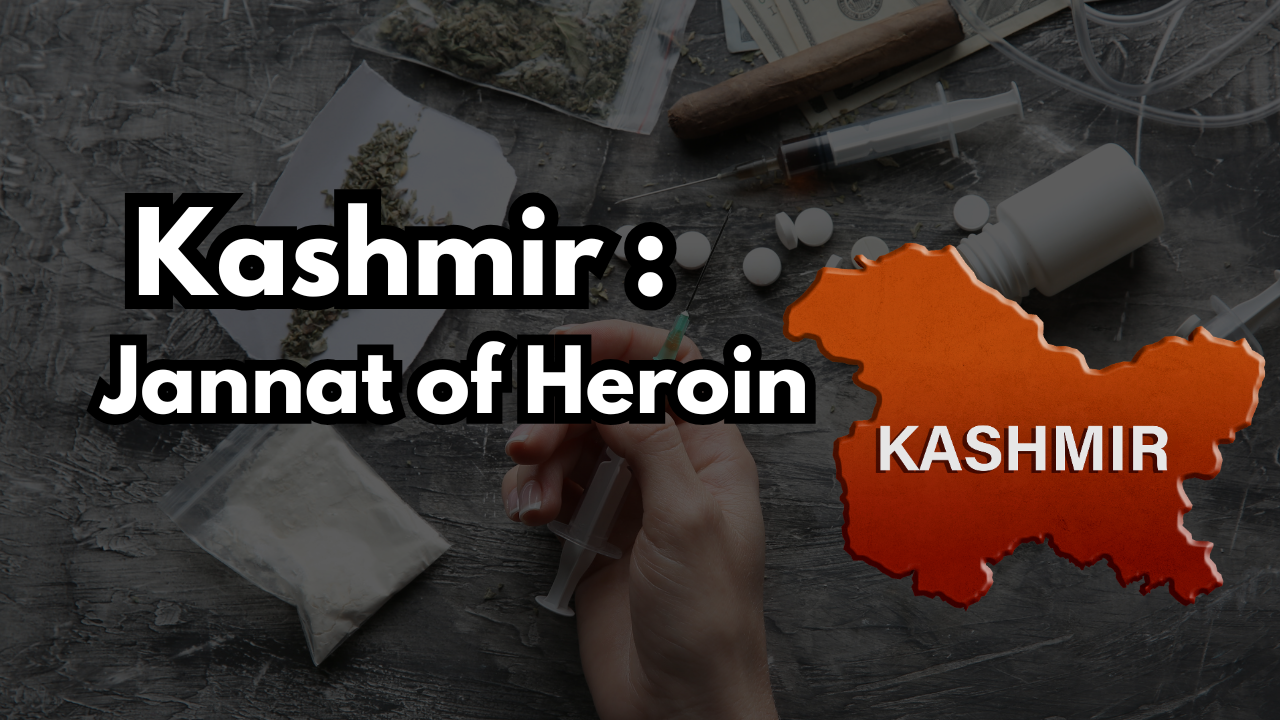
Much water has flown down the Jhelum river. Today’s
youth see Jannat (Paradise) not in the snow capped
mountains, but in the powdery white Heroin. A whiff
drifts them to paradise.
An anonymous Kashmiri youth says “This is a sweet
poison that will destroy you.”
Kashmir is battling an alarming white Heroin blizzard –
a drug addiction crisis, with an estimated 1 million
individuals grappling with Heroin abuse. Driven
primarily by an explosive surge in intravenous heroin
use, the epidemic has rapidly expanded to affect
teenagers as young as 12!
Drug abuse in Kashmir is rampant, with the main
rehabilitation facility in Srinagar reporting a 2660%
increase in patients seeking treatment since 2016,
primarily for heroin addiction. The number of people
who require help is twice the national average. Addicts
are rich and poor, employed and unemployed and
overwhelmingly young.
A parliamentary panel report in 2023 had revealed that
13.5 lakh people in Jammu and Kashmir, or 10 per cent
of the Union Territory’s population, were consuming
drugs. They included five lakh addicts using opioids.
The administration has roped in the Ulema, Islamic
scholars and imams to launch a grassroots campaign
against substance abuse. The scholars have been
instructed to use mosque pulpits to spread awareness.
On April 17 th 2026, Lieutenant Governor Manoj Sinha
had stressed that drug abuse is not just any average
law and order problem but a very serious societal
threat that requires a united and collective response.
Addressing a rally in Ramban he said: “Drug abuse isn’t
just a law & order issue but a social cancer requiring
every part of society to fight. I urge Whole of Government’ andWhole of `Whole of Society’
approach. I believe when the government’s strength
and society’s resolve act as one, then even the
toughest challenges crumble.”. Sinha led a padyatra
from District Police Lines to District Administrative
Complex, Ramban. He was joined by public
representatives, senior officials of civil and police
administration, civil society members, religious leaders,
members of the business and trade community, ex-
servicemen, prominent citizens, various stakeholders,
women, students, and youth. People from different
walks of life joined. him in large numbers and resolved
to eradicate drug addiction at its roots, transform
society, and secure youth’s future.
Complicating law enforcement, is the “crime-terror
nexus”—the intersection where extremist groups
engage in illicit drug trafficking to finance operations,
secure supply routes, and exploit porous borders. Drug
funded terrorism has been relentlessly battering the
Kashmir valley. The illegal drug trade bankrolls
terrorism in Kashmir. Dismantling drug trafficking
networks and infrastructure needs international
cooperation targeting both the supply and demand
sides. Pakistan’s Inter-Services Intelligence (ISI) is
silently conducting an international narcotics industry
and orchestrates a narco-terror nexus in Kashmir,
using illegal drug networks to finance militant
operations and introduce a non-traditional weapon to
weaken Indian security. The cross-border smuggling
heavily exploits the region, devastating local youth
while fueling separatism through 2.5+ billion in
earnings. By flooding the valley with abundant cheap
heroin and opium, the ISI deliberately foments
substance abuse as a non-traditional warfare tactic to
destabilize the socio-economic and cultural fabric of the
Kashmiris. Bypassing fortified traditional border routes,
the ISI utilizes a clandestine supply chain that funnels
drugs via drones across the Rajasthan and Punjab
borders, and also in Kashmir. From there, the
contraband is transported via established road
networks directly into Kashmir. Heroin and other drugs
generate instant cash without leaving any paper trail.
The illegal drug earnings are laundered and then
passed on to hardcore terror groups—such as Jaish-e-
Mohammed (JeM) and Lashkar-e-Taiba (LeT)—to fund
recruitments, procure weapons, and purchase logistical
support on the ground.
Another emerging area of concern is university and
educational institutions based drug rings. Narcotics
networks target universities and educational
institutions as these are potentially highly lucrative
markets for synthetic drugs and as recruitment hubs to
establish local distribution chains. Drug syndicates and
extremist organizations leverage these networks as a
dual mechanism: to destabilize the youth demographic
and to finance broader terrorist activities.
Medical professionals and government surveys in
Kashmir estimate that a significant percentage of
young people in the region are affected by substance
abuse, with a sharp increase in the number of minors
and teenagers seeking treatment. UNODC in its
“Handbook on Children Recruited and Exploited by
Terrorist and Violent Extremist Groups: The Role of the
Justice System” has this to say “Children who have
been recruited and exploited by terrorist and violent
extremist groups are victims of violence at multiple
levels. They are often victims of extreme violence
during their association with the group; which includes
ferocious recruitment methods, enslavement, sexual
exploitation, exposure to constant fear, indoctrination
and psychological pressure. They are often injured or
killed in combat. At the same time, because of their
young age and psychological malleability, such children
may become particularly dangerous instruments of the
groups that recruited them, as the children may be
used for committing criminal offences, including, in
certain cases, acts of terrorism, war crimes or crimes
against humanity.”
About the author:
Dr G Shreekumar Menon, IRS (Rtd) Ph. D (Narcotics),
Former Director General National Academy of Customs Indirect Taxes and Narcotics,
& Multi-Disciplinary School of Economic Intelligence India,
Fellow, James Martin Centre for Non – Proliferation Studies, USA.
Fellow, Centre for International Trade & Security, University of Georgia, USA
AOTS Scholar, Japan
Former Trustee New Mangalore Port Trust, Karnataka
UNODC Consultant on Narcotics & Psychotropic Substances
Former Registrar, Yenepoya Deemed to be University
Former Head, CNPS, MAHE, Manipal.

Leave a Reply